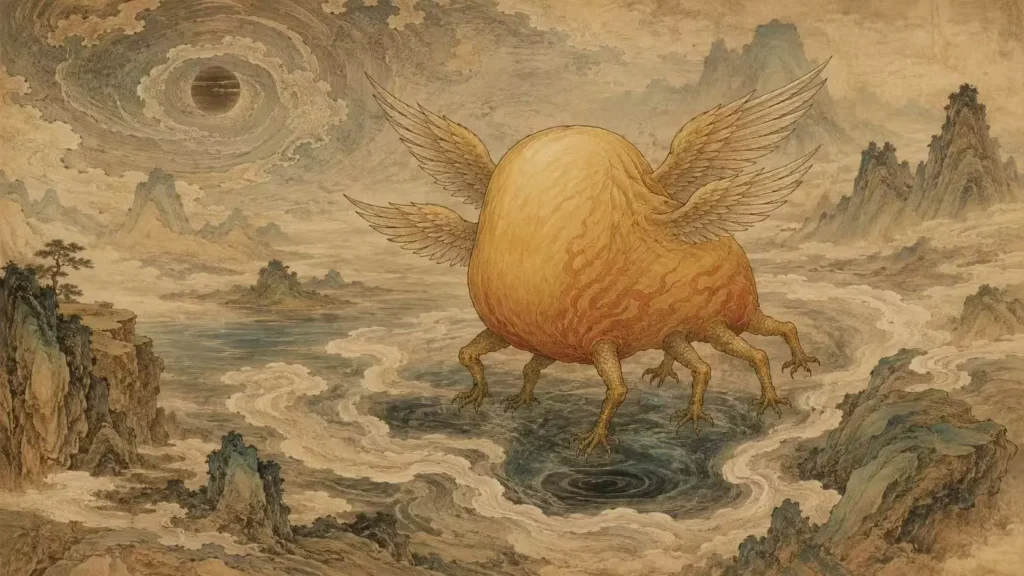
Some creatures become unforgettable because they are terrifying.
Others become unforgettable because they should not be possible.
Dijiang belongs to the second kind.
In ancient Chinese mythology, this strange being had no face. No eyes. No ears. No mouth. And yet it could still sing and dance.
It did not fight famous heroes.
It did not rule Heaven.
It did not tempt kings or destroy kingdoms.
It simply existed—impossible, mysterious and deeply symbolic.
Dijiang (帝江, Dìjiāng) is one of the strangest beings in the Shan Hai Jing, or Classic of Mountains and Seas. Its description is brief, but powerful enough to make it one of the most memorable creatures in all of Chinese mythology.
What Is Dijiang?
The earliest and most important description of Dijiang appears in the Shan Hai Jing.
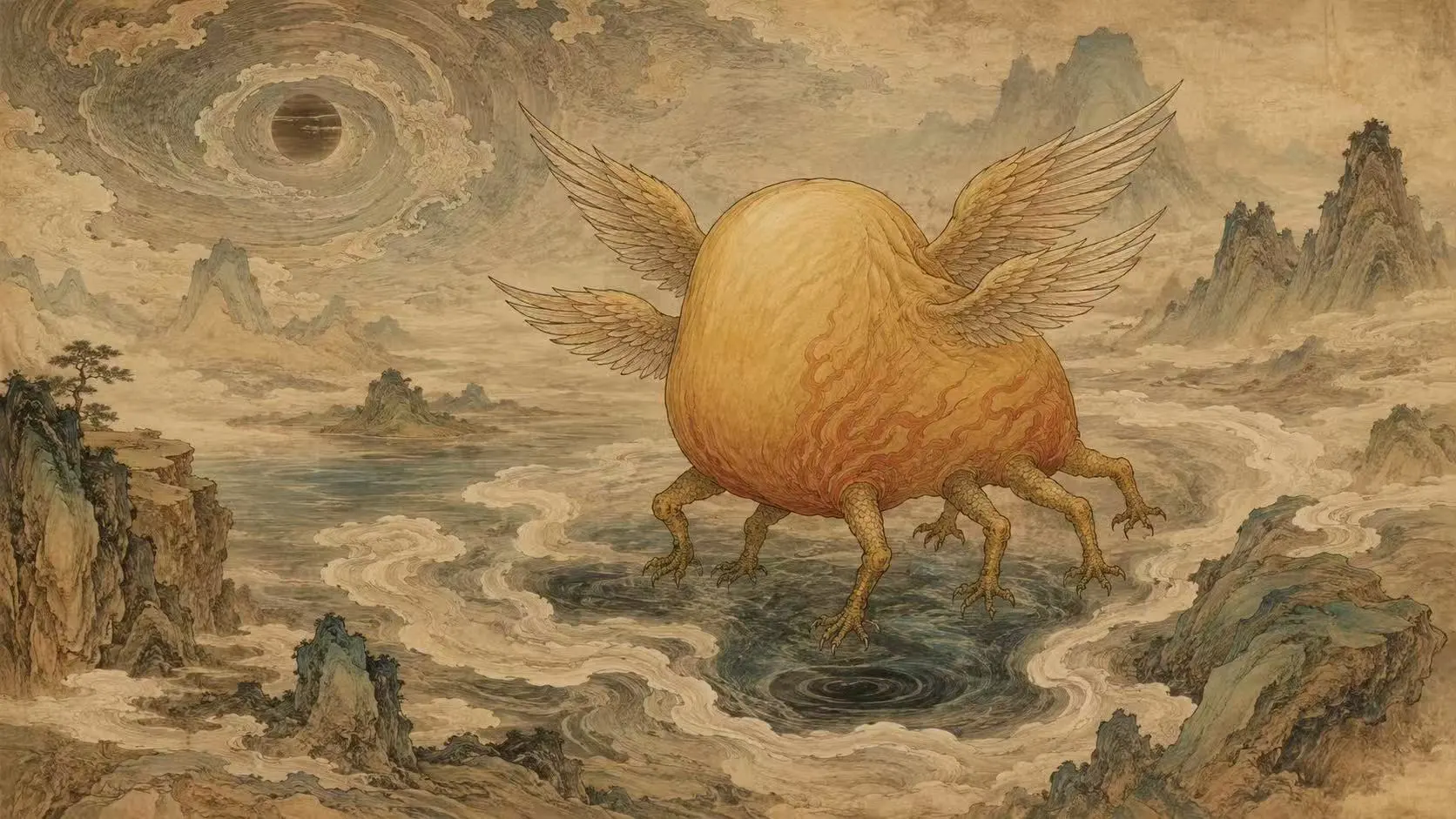
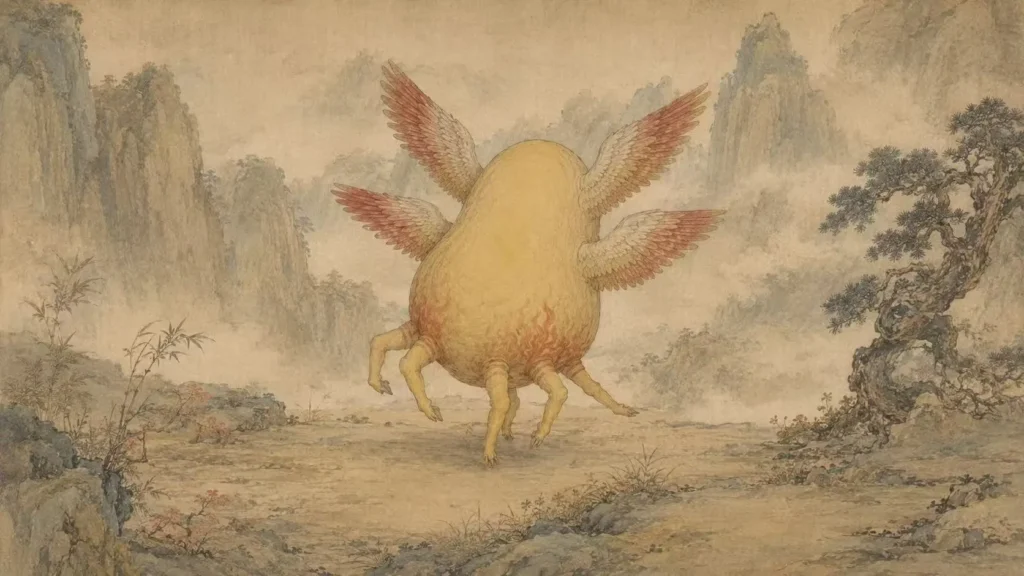
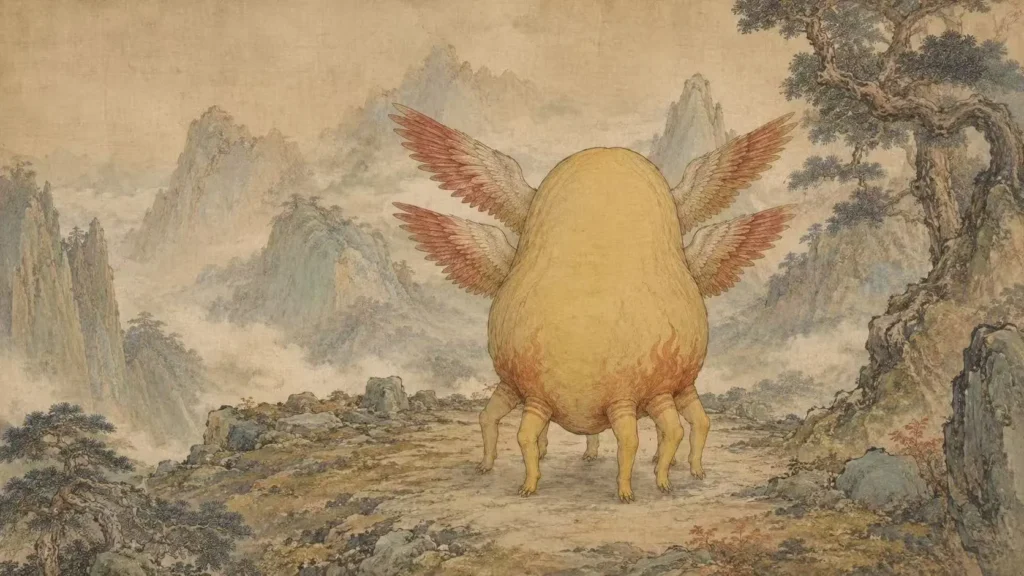
There, Dijiang is described as a divine being whose shape resembles a yellow sack. It is red like fire, has six legs and four wings, and has no face at all. No features appear on its head—yet it still knows how to sing and dance.
That is the image that survived.
A living contradiction.
A being without the organs normally associated with perception or expression, yet still capable of music and movement.
This is what makes Dijiang so striking.
Most mythical creatures are built out of familiar parts: dragon scales, tiger claws, bird wings, human faces.
Dijiang is different.
It feels older than classification itself.
A Creature Beyond Ordinary Logic
At first glance, Dijiang sounds almost absurd.
How can something without eyes see?
How can something without ears hear?
How can something without a mouth sing?
The ancient text does not explain any of this.
It simply describes the creature and moves on.
That silence matters.
The Shan Hai Jing often presents strange beings without offering complete interpretation. It records the wonder, but not always the meaning. That leaves later readers to reflect on why such a creature was imagined in the first place.
Dijiang seems to resist the normal structure of the world.
It does not follow the logic of anatomy.
It does not need ordinary form in order to possess vitality.
And that is likely part of its deeper power.
Is Dijiang the Same as Hundun?
This is where things become more interesting—and more complicated.
Many readers connect Dijiang with Hundun (混沌, Hùndùn), the idea of primordial chaos. That is because the classical description includes the word hundun when portraying the creature’s faceless and undivided body.
Because of this, Dijiang is often interpreted as a being linked to the original, unformed state of existence—the world before order, separation and structure.
But we should be careful.
The original source names the creature Dijiang, not simply “Chaos” as an abstract concept. It is therefore better to say that Dijiang is associated with or described in terms that evoke primordial chaos, rather than claiming too confidently that it is nothing more than a personification of chaos itself.
That distinction matters.
Our goal is not to flatten ancient mythology into modern simplifications.
It is to preserve the mystery without inventing certainty.
Why Singing and Dancing Matter
The most beautiful part of the Dijiang description is also the most unexpected.
It sings.
It dances.
That turns the creature from a mere curiosity into something almost sacred.
Singing and dancing are signs of rhythm, harmony and life. They suggest celebration, movement and presence. In many traditions, dance is not random motion—it is alignment with something larger.
This creates a fascinating tension.
Dijiang looks unfinished, formless, even alien.
And yet it expresses itself not through violence, but through art.
Not through destruction, but through rhythm.
That is one reason the creature stays in the mind.
It suggests that reality may contain forms of awareness that do not resemble our own.
What seems strange or incomplete from the outside may still carry its own hidden order.
Why Dijiang Still Feels Modern
A lot of mythological creatures remain trapped in the past.
Dijiang does not.
Even now, it feels unusual enough to stand out.
Modern audiences are used to monsters that are loud, aggressive and visually overloaded. Dijiang is memorable for the opposite reason. It is minimal, symbolic and unsettling in a quieter way.
It has no detailed legend cycle.
No famous battle.
No long novel built around it.
And maybe that is its strength.
The less the text explains, the more space it gives the imagination.
Dijiang survives because it leaves a mark without overexplaining itself.
That is rare.
The Lesson of Dijiang
Dijiang reminds us that not everything valuable arrives in a form we immediately understand.
The world is quick to respect what looks complete, impressive and easy to recognise.
But Dijiang challenges that instinct.
It has no face.
No ordinary beauty.
No clear usefulness.
And yet it still carries rhythm, vitality and presence.
That lesson matters far beyond mythology.
A person does not need to fit the expected mold to possess depth. Strength does not always look sharp and obvious. Wisdom does not always arrive in polished packaging. Some of the most important things in life are misunderstood at first because they do not resemble what people were trained to notice.
Dijiang could sing and dance without the features that should have made those things possible.
Sometimes true power is not about having the most obvious gifts.
It is about expressing life so fully that the world’s narrow categories no longer matter.
Reference:
Shan Hai Jing (Classic of Mountains and Seas) — the primary source for Dijiang’s description.
Traditional commentarial and later interpretive readings connecting the description to ideas of hundun / primordial chaos.