Changcheng: The Leopard-Tailed God of the Shan Hai Jing
Some gods in Chinese mythology rule storms.
Others command armies or guard the gates of Heaven.
Changcheng is remembered for something quieter.
Virtue.
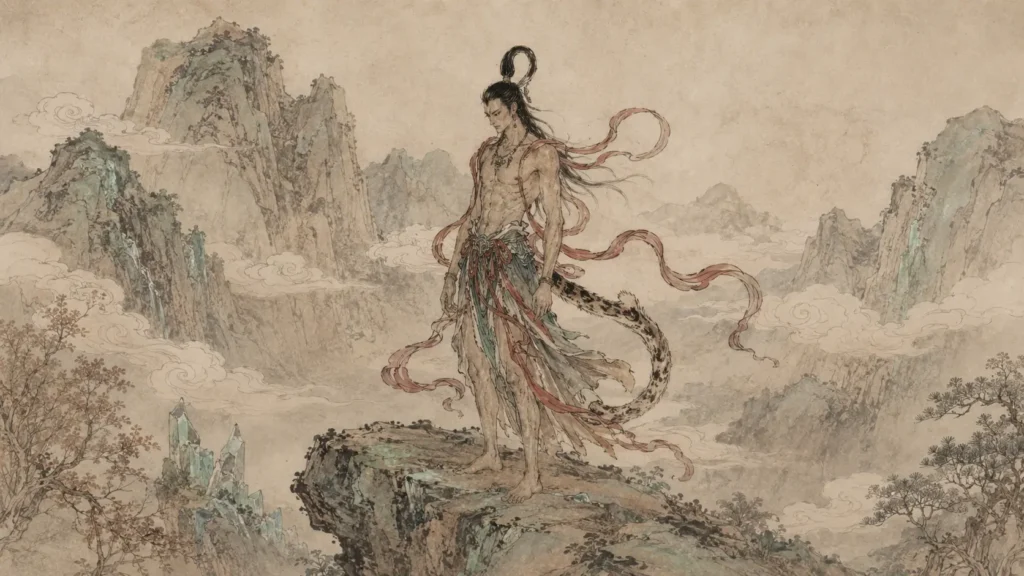
Deep within the western mountains of the Shan Hai Jing, an ancient text introduces a deity whose appearance is almost human—except for the strange tail behind him.
No weapon is named.
No battle follows.
Instead, Changcheng is connected with the Nine Virtues of Heaven.
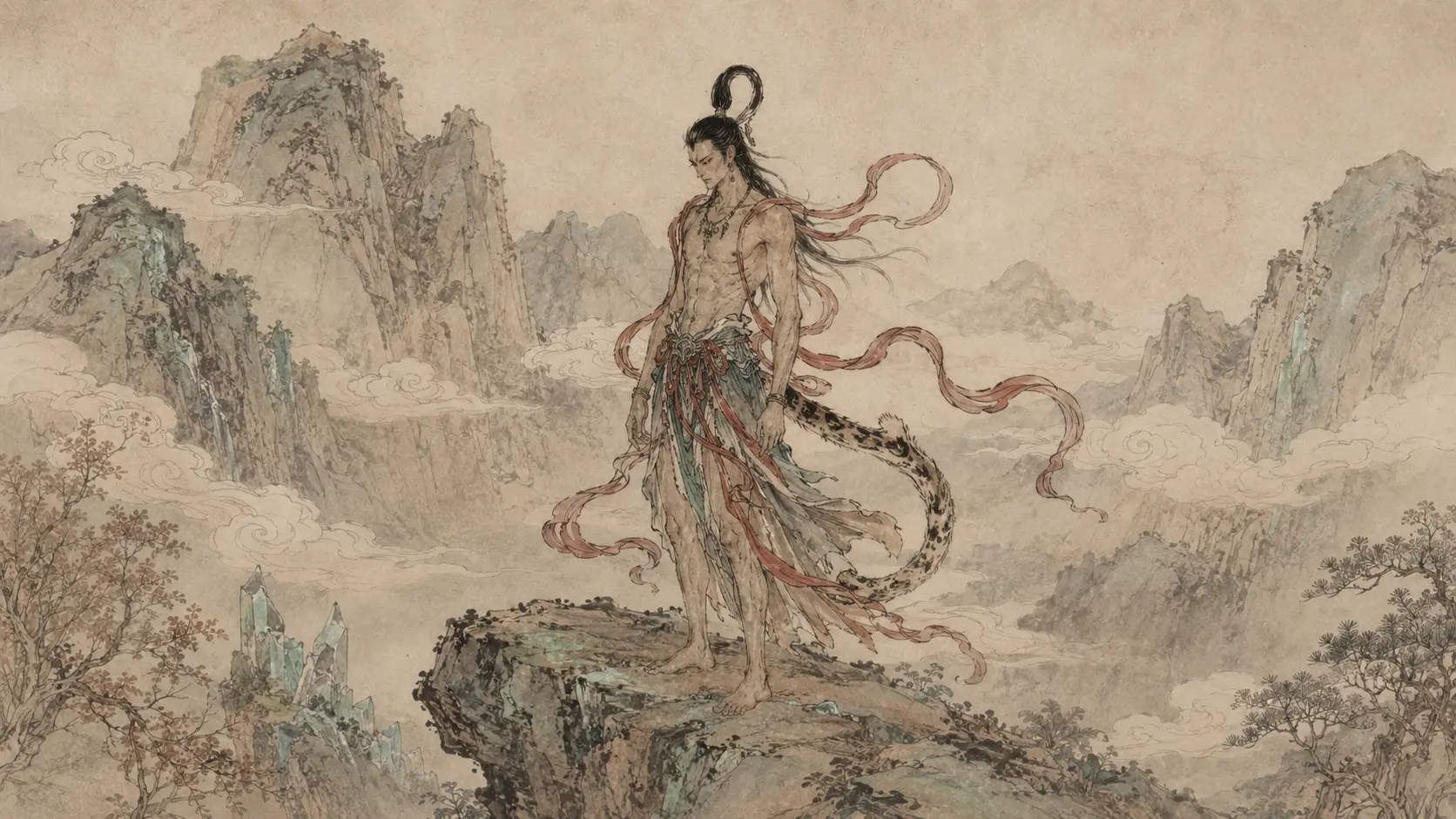
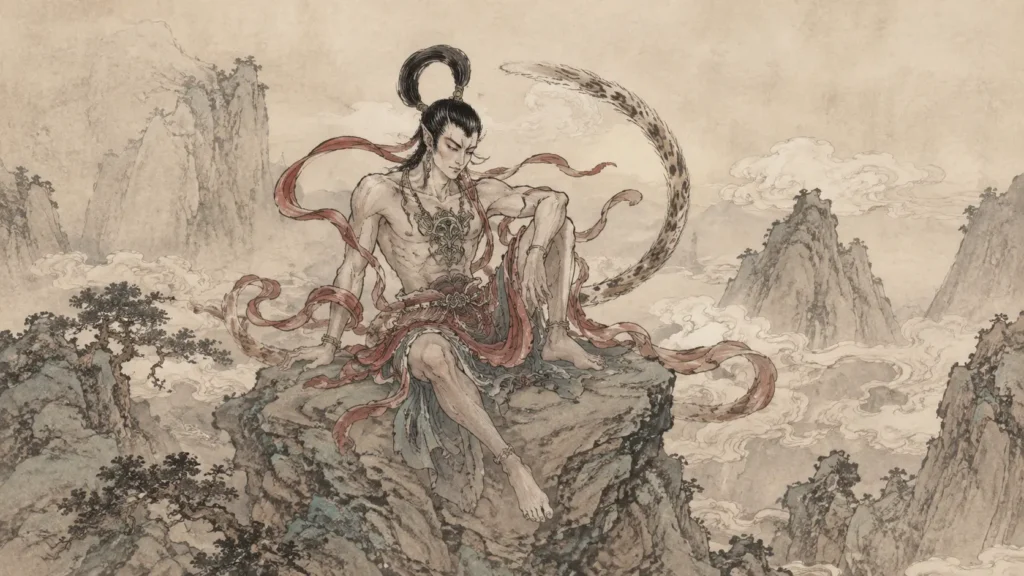
Changcheng (长乘 / 長乘, Chángchéng) is a mountain deity from the Western Mountains Classic of the Shan Hai Jing. He governs Mount Luomu and is associated with Heaven’s Nine Virtues. The ancient text describes him as human in form but possessing the tail of a leopard-like beast.
Who Is Changcheng?
Changcheng appears in the Xishan Jing (西山经), or Classic of the Western Mountains.
After describing a journey across the shifting sands, the text reaches Mount Luomu (蠃母之山).
There it says:
神长乘司之,是天之九德也。其神状如人而犳尾。
In natural English:
The god Changcheng governs it. He is of Heaven’s Nine Virtues. The god is shaped like a human but has the tail of a leopard-like beast.
The mountain itself is described as rich in jade above and blue-green stone below, but without water.
That is essentially Changcheng’s entire original description.
Like many Shan Hai Jing deities, a few lines carry the whole image.
A Human God With a Leopard-Like Tail
Changcheng is not described as a full animal-human hybrid.
The text says:
其神状如人 — “the god’s form is like a human.”
Only the tail breaks that human appearance.
The difficult word is 犳.
Later readers often simplify the passage as “human with a leopard’s tail,” and that is a reasonable visual translation. However, ancient dictionary traditions describe 犳 as a leopard-like animal, sometimes specifically one without the familiar spotted pattern.
So the safest reconstruction is:
a predominantly human deity with a leopard-like tail.
The original text does not mention horns.
It does not describe claws.
It gives Changcheng no animal head, wings, armor, ribbons, magical flames, or supernatural weapon.
Those may appear in modern illustrations, but they are artistic interpretation rather than ancient description.
What Are Changcheng’s Nine Virtues?
The most unusual line about Changcheng is:
是天之九德也
The deity is associated with Heaven’s Nine Virtues.
Guo Pu’s commentary explains this through 九德之气 — the qi or vital force of the Nine Virtues, and his poetic Shan Hai Jing Tu Zan states that the qi of the Nine Virtues gave rise to Changcheng.
That makes Changcheng different from many mountain gods defined mainly through location or physical appearance.
His identity is linked directly to 德 — virtue.
However, the Shan Hai Jing itself does not list nine individual virtues in this passage.
Later Chinese texts contain different traditions concerning groups of nine virtues, but we should not automatically import one later list and claim that it was definitely what the Shan Hai Jing meant.
What the ancient passage safely tells us is simpler:
Changcheng represents or arises from a heavenly concentration of Nine Virtues.
The God of Mount Luomu
Changcheng is not presented as a wandering deity.
The text uses 司, indicating that he presides over or governs Mount Luomu.
This fits a recurring pattern throughout the Shan Hai Jing.
Mountains are not merely landscapes.
Many have divine beings connected with them—spirits whose strange bodies and duties help define the sacred geography of the text.
Mount Luomu itself reinforces Changcheng’s unusual setting.
The mountain contains abundant jade in its upper regions and blue-green stone below, yet the text specifically states that it has no water.
The source never explains whether those minerals had any connection with Changcheng.
Linking the jade directly to his power or symbolism would therefore go beyond the evidence.
Did Changcheng Meet Yu the Great?
Centuries after the Shan Hai Jing, another story became connected with Changcheng.
The Shui Jing Zhu (水经注) records a tradition in which Yu the Great, while controlling the floods, travelled west to the Tao River.
There he encountered a “tall person” — 长人 and received a Black Jade Book (黑玉书).
The ancient account does not name that tall person Changcheng.
The connection comes much later.
Qing scholar Hao Yixing suggested that the mysterious “tall person” encountered by Yu might have been Changcheng. His commentary explicitly presents this as a possibility—疑即此神, roughly, “perhaps this was this very god.”
That distinction matters.
We can say:
A later scholar connected Changcheng with the mysterious figure who gave Yu the Black Jade Book.
We should not say:
The Shan Hai Jing tells us Changcheng gave Yu the book.
It does not.
What Powers Did Changcheng Have?
The original Shan Hai Jing gives Changcheng no explicit supernatural abilities.
There is no statement that he:
- controls fire;
- commands the weather;
- shapeshifts;
- fights demons;
- grants immortality;
- protects warriors;
- controls jade.
His divine status is clear.
His association with the Nine Virtues is clear.
His position as the deity governing Mount Luomu is clear.
Beyond that, the source remains silent.
Modern games and fantasy reinterpretations can give Changcheng elaborate abilities, but those should not be mistaken for ancient mythology.
Why Changcheng Is Worth Remembering
Changcheng does not have one of the longest stories in Chinese mythology.
Perhaps that is exactly why he is interesting.
A traveler crosses the western wilderness.
Past the shifting sands stands a mountain without water.
Jade lies above.
Blue-green stone rests below.
And there, governing the mountain, is a god who looks almost human.
Almost.
A leopard-like tail follows behind him.
The text gives us no battle and no threat.
Instead, it leaves Changcheng associated with something far less common among the strange beings of the Shan Hai Jing:
the Nine Virtues of Heaven.
More than two thousand years later, that brief description is still enough to make the forgotten god of Mount Luomu worth finding again.
Reference:
1. Shan Hai Jing — Xishan Jing (Western Mountains Classic)
Primary ancient passage describing Mount Luomu, Changcheng, the Nine Virtues and his human form with a leopard-like tail.