Some mythical creatures survive because they were powerful.
Others because they were terrifying.
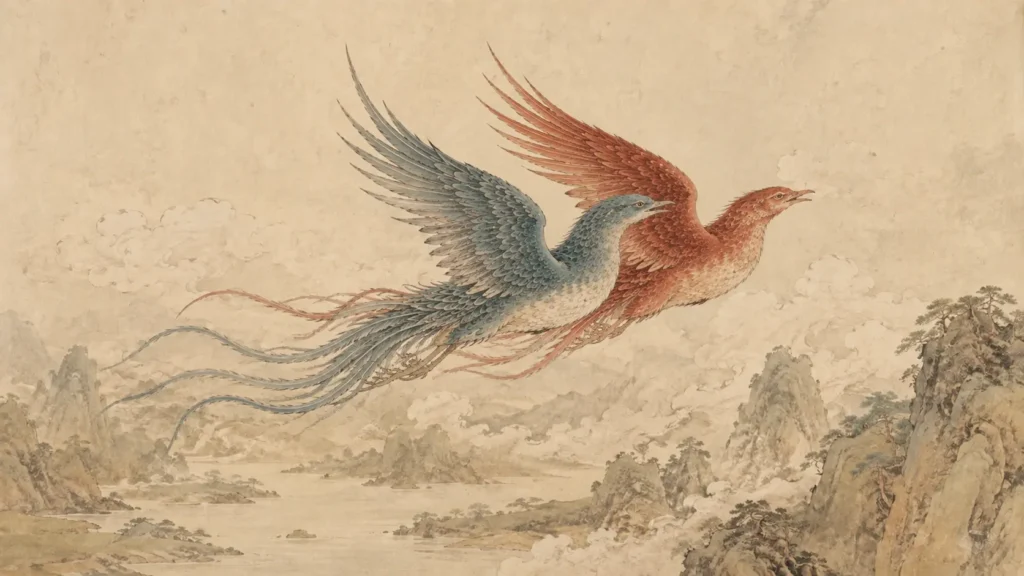
The Biyiniao survived because two birds could do together what neither could do alone.
Ancient Chinese texts imagined a pair so closely connected that flight itself depended on their union.
One was associated with blue-green coloring.
The other with red.
And over centuries, this strange image escaped the pages of an ancient bestiary and became one of China’s most enduring metaphors for inseparable love.
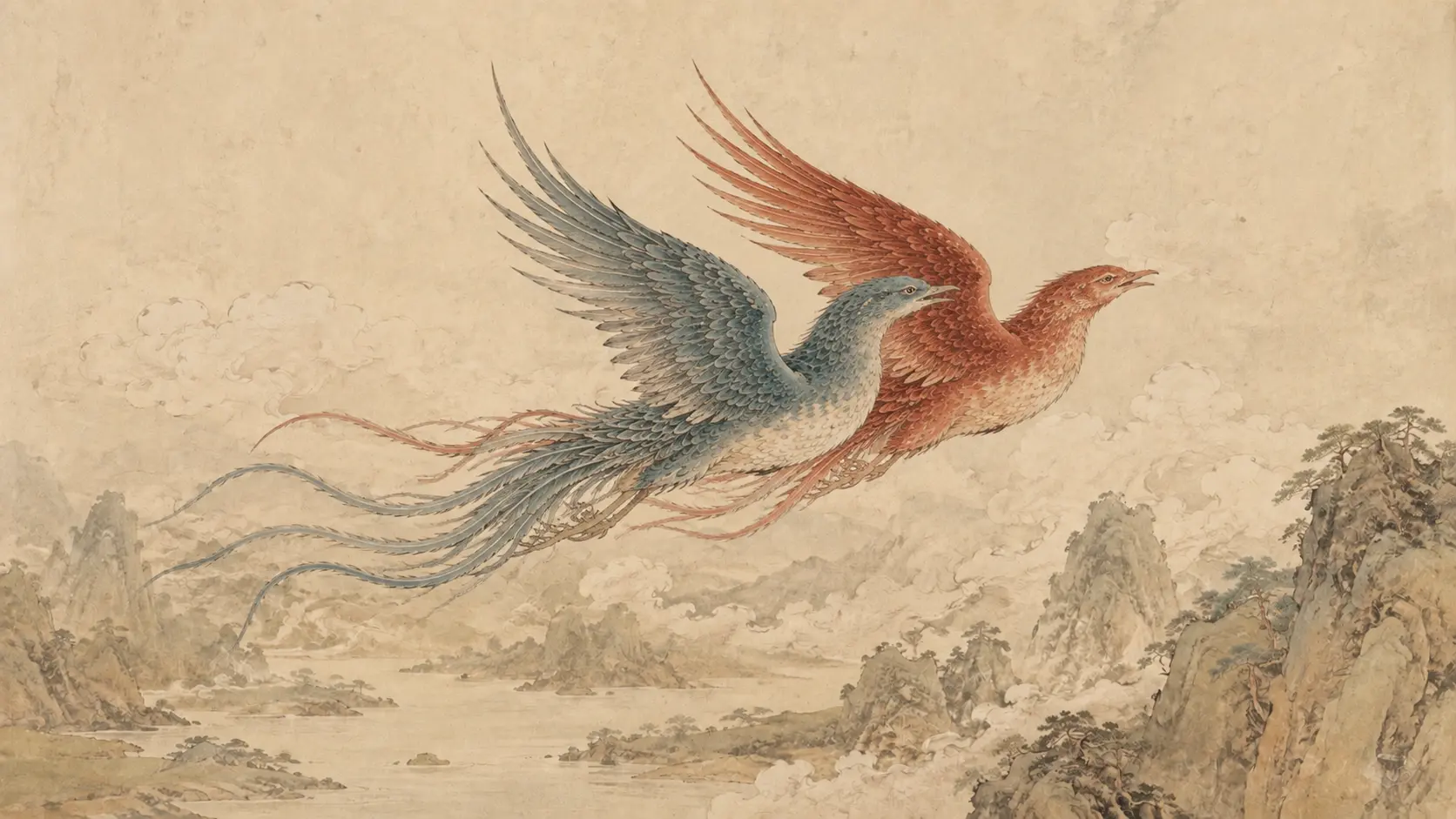
Biyiniao (比翼鸟, Bǐyìniǎo), or “paired-wing birds,” are legendary birds recorded in the Shan Hai Jing. One ancient passage describes a blue-green and red pair flying wing-to-wing. Related early traditions describe paired birds with one eye and one wing each that cannot fly unless they join together. In later Chinese literature, Biyiniao became a famous symbol of devoted lovers who never wish to be separated.
What Are the Biyiniao?
The Biyiniao appear in the Haiwai Nanjing (海外南经), the Classic of Regions Beyond the Seas: South.
The surviving passage is remarkably short:
比翼鸟在其东,其为鸟青、赤,两鸟比翼。一曰在南山东。
In natural English:
The Biyiniao are to its east. The birds are blue-green and red, and the two birds fly wing-to-wing. Another account places them east of Nanshan.
The ancient text does not give them a battle, magical weapon, or elaborate biography.
Instead, their identity is concentrated into a single image:
two differently colored birds joined in flight.
Guo Pu’s commentary adds that they resembled fú (凫), a type of wild duck or waterbird.
Did Biyiniao Really Have Only One Wing?
This is where the textual history becomes more interesting.
The short Haiwai Nanjing passage itself does not explicitly say that each Biyiniao has only one eye and one wing.
That famous detail appears clearly in related ancient traditions.
The Xishan Jing (西山经) describes a bird on Mount Chongwu (崇吾之山) called Manman (蛮蛮):
其状如凫,而一翼一目,相得乃飞,名曰蛮蛮。
It resembles a wild duck, possesses one wing and one eye, and can fly only when it finds its counterpart.
Guo Pu’s commentary explicitly identifies this Manman as a Biyiniao, noting the blue-green and red coloring and explaining that it cannot fly without being paired.
The ancient dictionary Erya preserves another closely related name:
Jianjian (鹣鹣).
It says that in the south there are Biyiniao that “do not fly unless paired.” Guo Pu’s commentary again describes them as duck-like, blue-green and red, with one eye and one wing.
So the safest conclusion is not that every surviving passage says exactly the same thing.
Rather, ancient commentators understood Biyiniao, Manman and Jianjian as closely connected versions of the same paired-bird tradition.
Two Birds That Cannot Fly Alone
That strange anatomy explains why the image became so powerful.
If each bird possesses only one functional wing, neither can take to the sky independently.
They must find one another.
They must align themselves.
Only then can they fly.
The Erya expresses the idea very simply:
不比不飞 — “without pairing, they do not fly.”
The ancient sources do not explain this through romance.
They do not tell us that the birds were lovers, married, or destined soulmates.
That meaning developed through later cultural interpretation.
But the foundation was already there:
two incomplete creatures whose movement depends upon remaining together.
Did the Biyiniao Predict a Great Flood?
Sometimes—but this requires an important distinction.
The Biyiniao passage in the Haiwai Nanjing does not say that their appearance causes or predicts disaster.
The flood omen belongs to the Manman passage in the Xishan Jing.
After describing the one-eyed, one-winged birds, the text states:
见则天下大水 — when they appear, great flooding occurs under Heaven.
Because Guo Pu later identifies Manman with Biyiniao, the flood association became attached to discussions of the paired-wing birds.
But it is more accurate to preserve the textual distinction instead of pretending every ancient Biyiniao account contains the same omen.
How Biyiniao Became a Symbol of Love
Centuries later, the paired birds took on a very different meaning.
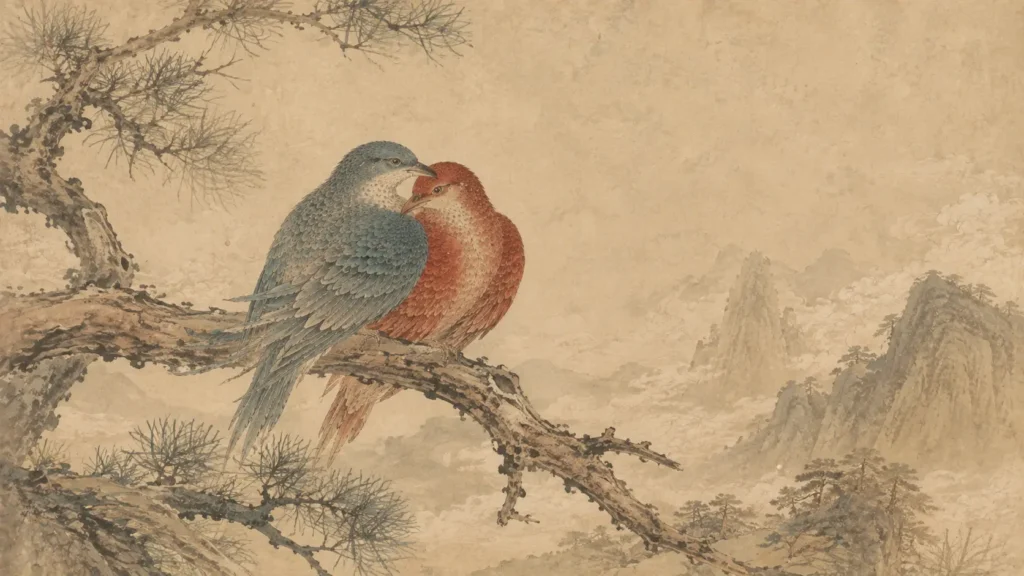
Instead of disaster, they became associated with inseparable affection and partnership.
The most famous example appears in Bai Juyi’s Chang Hen Ge (长恨歌), or Song of Everlasting Regret, written in the Tang dynasty.
Near the end of the poem, the lovers express the wish:
在天愿作比翼鸟,在地愿为连理枝。
In English:
In Heaven, may we become paired-wing birds; on Earth, may we become intertwined branches.
The poem links Biyiniao directly with the desire for two lovers to remain joined even beyond ordinary life.
From there, the image became one of the most recognizable poetic metaphors for a devoted couple in Chinese culture.
The expression 比翼双飞 — “to fly wing-to-wing together” still carries the idea of two people advancing through life together.
Were Biyiniao Male and Female?
Later tradition frequently interprets the pair as male and female, especially once Biyiniao became a symbol of romantic partnership.
However, we should be careful with the oldest passage.
The Haiwai Nanjing says there are two birds, one blue-green and one red, flying together.
It does not explicitly label one male and the other female.
The romantic male-female reading belongs more clearly to the later cultural life of the myth.
Again, that distinction does not make the story weaker.
It shows how mythology changes.
An ancient description of impossible paired birds eventually became an image through which generations of people expressed love.
Why Biyiniao Still Matters
Biyiniao began with almost nothing.
Two colors.
Two birds.
Two wings moving together.
Later traditions gave the creatures one eye and one wing each, making their dependence physical.
Poets then transformed that dependence into devotion.
And perhaps that is why Biyiniao survived when thousands of other strange creatures faded into obscure lines of ancient books.
A single bird cannot rise.
The pair can.
Thousands of years after the Shan Hai Jing first recorded them, that simple image still needs almost no explanation.
Some journeys were never meant to be flown alone.
Reference:
1. Shan Hai Jing — Dongshan Jing (Eastern Mountains Classic)
Primary ancient text for Beihao Mountain, Heju, Qique, and the fourth Eastern Mountains itinerary.