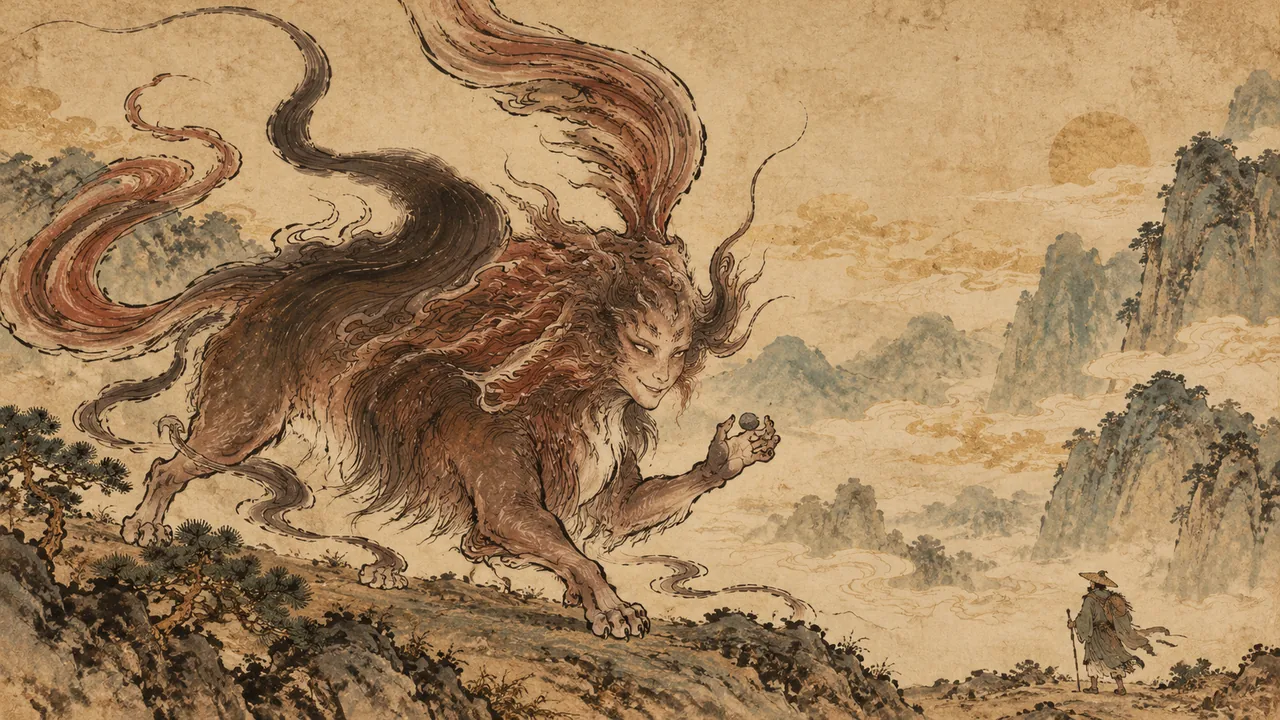
A face you might recognize looks out from the body of a dog.
When the creature sees a person, it laughs.
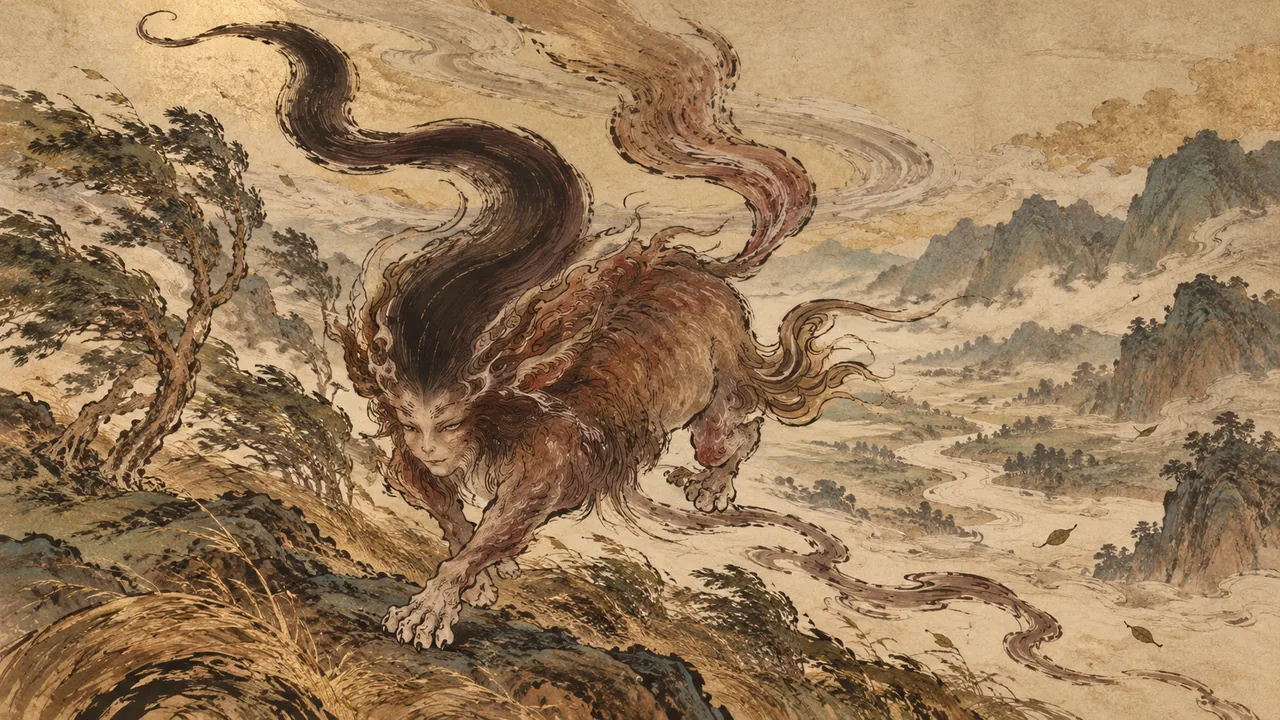
Then the mountain record widens its view. The sight of this beast foretells great winds across the land.
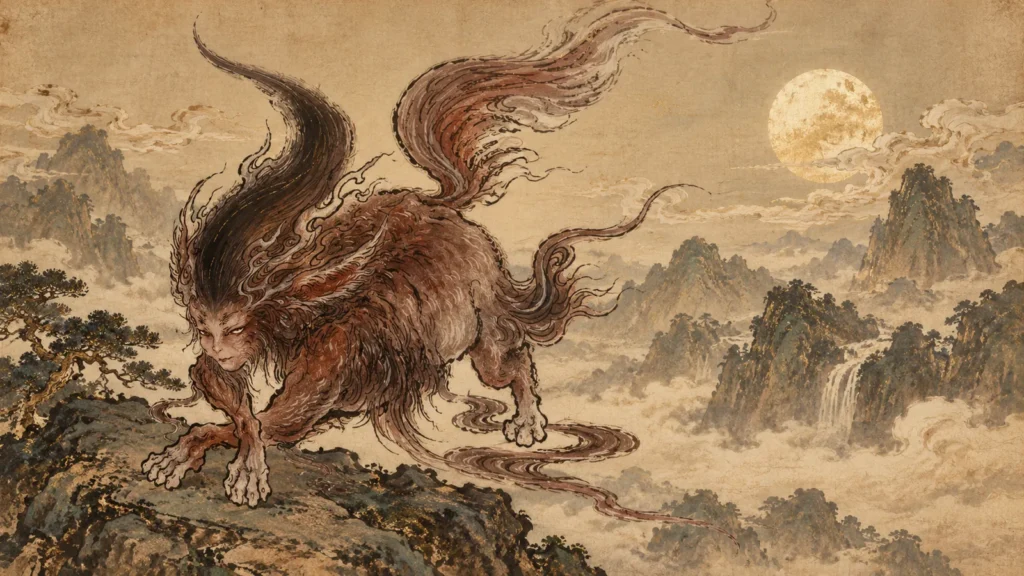
Shan Hui (山𤟤, Shān Huī) is a dog-like creature with a human face in the Northern Mountains section of the Shan Hai Jing. It lives on Mount Yuefa, is skilled at throwing, and laughs when it sees people. Its movement is likened to the wind. Its appearance is also an omen of great winds.
Shan Hui at a Glance
| Detail | Shan Hui |
|---|---|
| Chinese name | 山𤟤 (Shān Huī) |
| Source | Shan Hai Jing, Northern Mountains, first route |
| Location | Mount Yuefa (獄法之山 / 嶽法之山) |
| Appearance | Dog-like form with a human face |
| Behavior | Skilled at throwing and laughs on seeing people |
| Movement | As swift as the wind |
| Omen | Great winds across the land |
What Happens on Mount Yuefa?
The entry for Mount Yuefa opens with water. The Huaize River flows northeast into a marsh called Taize.
The account first describes an unusual fish in those waters. Then it turns to the beast with the human face.
That order matters. The mountain, water, fish and beast belong to the same entry. The text does not put Shan Hui in the river or explain how it arrived on the mountain.
The wider Shan Hai Jing creature collection shows how often these short accounts move from terrain to an animal in just a few lines.
A Human Face and a Laugh
The text gives Shan Hui a dog-like form and a human face. It says nothing about the length of its fur or the color of its eyes.
The next detail is an action. Shan Hui laughs at the sight of people. There is no conversation and no description of what the people do in return.
The laughter can feel friendly or unsettling, depending on how you picture the encounter. The text supplies the sound and leaves the mood open.
The Paoxiao of Mount Gouwu also has a human face, but its sound is compared to a crying infant. Shan Hui laughs. The sound helps keep the two beasts distinct.
What Is Shan Hui Skilled at Throwing?
The phrase 善投 (shàn tóu) describes Shan Hui as good at throwing. The passage gives it no named weapon and never says what it throws.
It is easy to imagine a stone in its hand. That would be a choice for an illustration, not a detail supplied by the entry.
The text tells us what the beast can do, then moves on. It spends more time linking Shan Hui to the wind than explaining its throwing.
Does Shan Hui Bring the Wind?
The entry makes two different statements. Shan Hui moves like the wind, and the sight of it foretells great winds across the land.
The first describes the creature’s movement. In the annotated text, Guo Pu glosses the comparison as a reference to speed.
The second describes an omen. The passage does not tell us that Shan Hui summons a storm, controls the weather or uses wind as a weapon.
Lihu, the human-footed bird, carries a different omen in the Eastern Mountains. Its appearance signals large construction works. Both entries tell the reader what an encounter might mean beyond the place where it happens.
How to Read the Name and the Image
The classical edition writes the name 山𤟤. Guo Pu’s pronunciation note gives the rare second character the sound of 暉, which supports the reading Shān Huī.
The modern illustrated edition also supplies 音灰 as a reading aid. The classical spelling 山𤟤 is retained here so readers can find the passage in the annotated edition.
The illustrations on this page follow the book’s sweeping mane and low, forward posture. Those are visual interpretations. The classical entry gives us the dog-like form, the human face, the laughter and the wind.
It leaves us with a brief encounter. A creature sees a person and laughs. The next thing to watch is the sky.