For years, the water would not stop.
Rivers spread across the land. Fields disappeared. Mountains became islands above a flooded world.
Yu’s father had already tried to control the disaster.
He failed.
Then the responsibility passed to his son.
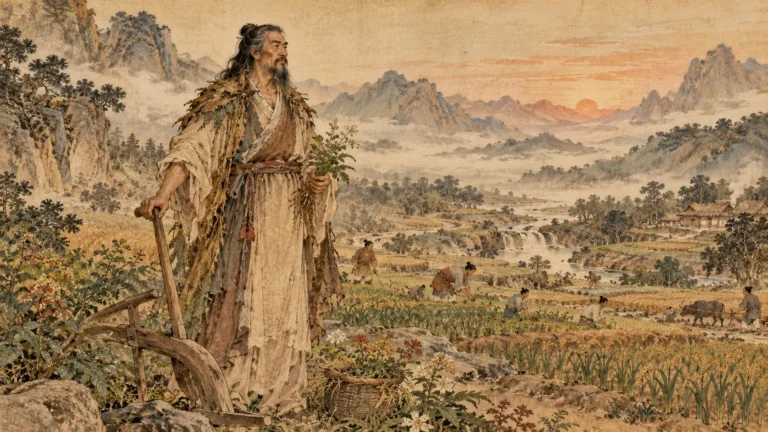
Yu the Great (大禹, Dà Yǔ) became one of the most important culture heroes in Chinese tradition because he did not defeat the flood by destroying it.
He learned how to guide it.
Ancient texts remember Yu as the man who opened waterways, restored habitable land and put public duty above his own home. Later tradition also made him the founder of the Xia dynasty, traditionally regarded as China’s first dynasty.
But Yu stands on the border between myth, legendary history and archaeology.
And separating those layers makes his story much more interesting.
Yu the Great Quick Facts
| Chinese name | 大禹 |
| Pinyin | Dà Yǔ |
| Meaning | Yu the Great |
| Father | Gun (鲧) |
| Main legend | Controlling the Great Flood |
| Associated rulers | Yao and Shun |
| Traditional dynasty | Xia |
| Famous virtue | Selfless public service |
| Important sources | Mencius, Shiji, Book of Documents, Shan Hai Jing |
| Historical status | Legendary; not independently confirmed as a historical individual |
Who Was Yu the Great?
Yu the Great is the legendary Chinese culture hero who brought a catastrophic flood under control and was later remembered as the founder of the Xia dynasty.
Sima Qian’s Records of the Grand Historian identifies Yu as the son of Gun and places him within the lineage of the Yellow Emperor. It describes him as diligent, trustworthy and devoted to restoring order after his father’s failure. Chinese Text Project
But this should not be read like a modern biography.
The traditional events attributed to Yu belong to a period long before the surviving historical texts that describe him were written.
For that reason, Yu is safest understood as a legendary ruler and culture hero, even though generations of Chinese historical tradition treated him as an early king.

The Great Flood Before Yu
According to the traditional narrative, the disaster begins during the age of Emperor Yao.
The flood rises across the land, surrounding mountains and overwhelming communities.
Yao turns to Yu’s father, Gun, for help.
Gun spends nine years trying to control the waters, but the project fails. In Sima Qian’s account, Gun is eventually punished, and Shun appoints Yu to continue the work his father could not finish. Chinese Text Project
This father-and-son structure became one of the strongest contrasts in the legend.
Gun fails.
Yu inherits the same impossible problem.
But Yu approaches it differently.
Like Nüwa Mends the Sky, Yu’s flood story imagines order being restored after a world-threatening catastrophe.
How Did Yu Control the Flood?
The central idea of the Yu legend is not simply that he worked harder than his father.
He worked differently.
Traditional accounts describe Yu opening river courses, clearing waterways and directing water toward larger rivers and the seas instead of relying only on barriers.
In the Shiji, Yu describes opening the nine streams toward the four seas and deepening channels so that water could move through the landscape rather than remain trapped across it. Chinese Text Project
That contrast later became one of the most memorable lessons of the story:
Gun tried to resist the water.
Yu learned how to give it somewhere to go.
It is tempting to turn this into a modern engineering manual, but the ancient texts are doing more than describing hydraulic construction.
Yu is also reorganizing the world.
Rivers flow properly.
Land becomes habitable.
Food production returns.
Chaos becomes order.
Did Yu Really Work for Thirteen Years?
The famous version says Yu spent thirteen years working away from home.
Sima Qian’s Annals of the Xia explicitly gives thirteen years and says Yu passed his own doorway without daring to enter because his work remained unfinished. Chinese Text Project
But the textual tradition is not completely uniform.
A passage preserved in Mencius describes Yu as spending eight years outside while managing the waters and passing his home three times without entering. Another Mencius passage praises Yu for repeatedly passing his own door because he felt personally responsible for people suffering in the flood. Chinese Text Project
That variation is worth keeping.
The important point is not whether every source agrees on the exact number of years.
The enduring image is Yu’s refusal to abandon the public task for private comfort.
Three Times Past His Own Door
Few moments define Yu better than this one.
He comes close enough to his own home to enter.
He does not.
Then it happens again.
And again.
Later tradition expanded the scene into an emotional story involving his wife and son, but the core motif is already present in early philosophical literature.
Mencius uses Yu as an example of extraordinary responsibility: Yu behaved as though people drowning elsewhere were drowning because he himself had failed them. Chinese Text Project
That transforms Yu from a flood fighter into a political ideal.
His greatness comes not only from controlling water.
It comes from treating the suffering of strangers as his own responsibility.
Yu the Great and Xiangliu
The Yu tradition also crosses directly into the mythological world of the Shan Hai Jing.
There, Yu confronts Xiangliu, the nine-headed serpent-like minister of Gonggong.
The text describes Xiangliu as a destructive being whose movements turn land into marshes. Yu kills him, but even the creature’s blood is so foul that crops cannot grow where it falls. Chinese Text Project
This episode makes Yu much more than an engineer.
In one tradition he redirects rivers.
In another, he kills a nine-headed monster.
Both stories express the same larger idea:
Yu makes a dangerous landscape fit for human life.
When we publish the dedicated Xiangliu article later, this should become one of the strongest internal links between the two pages.

Did Yu Found the Xia Dynasty?
Traditional Chinese historiography says yes.
In Sima Qian’s narrative, Shun eventually presents Yu as his successor. After Shun’s death and mourning period, other rulers turn toward Yu, and he takes the throne under the Xia name.
After Yu’s own death, his son Qi ultimately succeeds him. This later became closely associated with the beginning of hereditary dynastic rule. Chinese Text Project
But there is an important historical distinction.
The Xia dynasty and Yu’s historical existence remain debated.
The traditional accounts were written long after the era in which Yu supposedly lived, and scholars cannot simply treat every element of the legend as contemporary evidence.
So we should say:
Yu is traditionally regarded as the founder of Xia.
Not:
Archaeology has proven that Yu founded Xia.
Did Archaeologists Find Evidence of Yu’s Great Flood?
This is where the story becomes especially interesting.
In 2016, researchers published evidence in Science for an enormous earthquake-triggered outburst flood on the upper Yellow River around 1920 BCE.
The researchers proposed that this disaster could help explain the later Chinese Great Flood tradition and noted that its date falls close to the emergence of the Erlitou culture, which some scholars associate with the Xia. PubMed
But this did not prove Yu existed.
And it did not end the debate.
Other scholars have argued that the early Yu stories do not describe one identifiable Yellow River disaster at all, but instead present a much broader myth about making the world habitable by directing waters into their proper courses. ScienceDirect
Recent archaeological discussion continues to treat attempts to identify a single historical “Great Flood” with caution, and alternative geographic interpretations have also been proposed. OUP Academic
The safest conclusion is therefore:
Ancient China experienced major floods, and archaeology has found dramatic prehistoric flood events. But no discovery has proved that one specific flood was the event controlled by a historical Yu the Great.
Why Yu the Great Matters
Many heroes become legendary because they kill something.
Yu becomes legendary because he fixes something.
He inherits failure.
He studies the problem.
He spends years working through it.
And when the old solution does not work, he changes the method instead of repeating it.
That is why Yu became more than a figure from a flood story.
He became an image of leadership.
The flood represents disorder that appears too large for one person to solve.
Yu answers it with patience, organization and responsibility.
There is no single arrow that saves the world.
No instant miracle.
Only the long work of directing chaos until life becomes possible again.
And that may be the most powerful part of the legend:
Yu the Great does not conquer nature.
He learns how to work with it.
References
Sima Qian — Shiji, Annals of the Xia
One of the central traditional accounts of Gun, Yu’s flood-control work, the thirteen-year motif, Yu’s succession to Shun and the Xia tradition. Chinese Text Project
Chinese Text Project — Annals of the Xia
Mencius — Li Lou II / Teng Wen Gong tradition
Important early philosophical evidence for Yu passing his doorway three times and becoming a model of public responsibility. Chinese Text Project
Chinese Text Project — Mencius
Shan Hai Jing — Xiangliu passages
Primary mythological source connecting Yu with the killing of the nine-headed Xiangliu. Chinese Text Project
Chinese Text Project — Shan Hai Jing