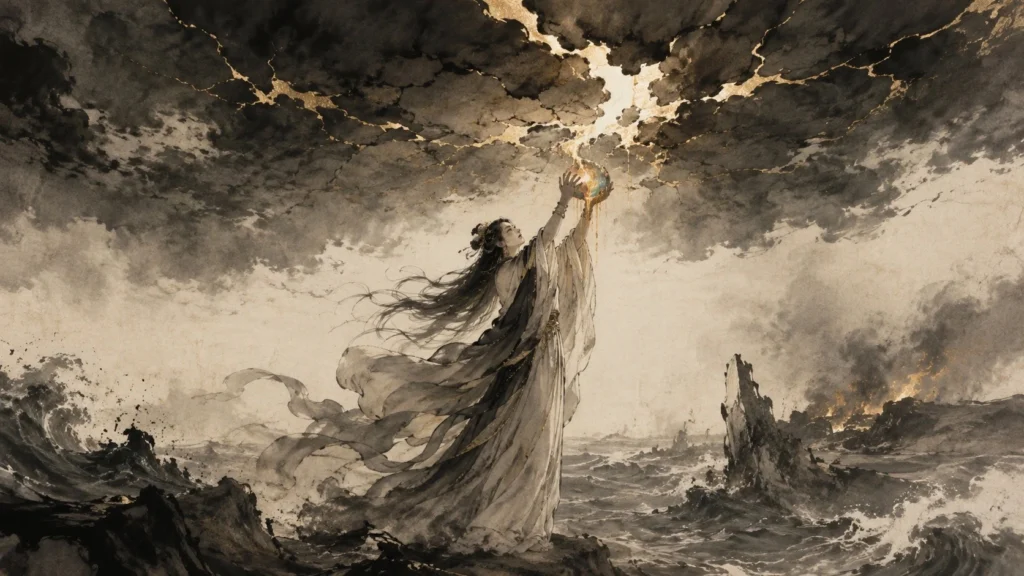
In Chinese mythology, Nüwa repaired the broken sky using five-colored stones after a cosmic catastrophe damaged the pillars supporting Heaven. By restoring the sky and saving humanity, she became a symbol of protection, order and renewal.
The sky had broken.
Fire spread across the land, floods covered the earth, and the pillars holding Heaven in place began to collapse. Wild creatures attacked the weak, while humanity stood helpless beneath a world falling into chaos.
According to Chinese mythology, only one goddess was powerful enough to restore what had been destroyed.
Nüwa melted five-colored stones to repair the sky, rebuilt the pillars of Heaven, and brought order back to the human world. It became one of the most famous stories of protection, sacrifice, and renewal in Chinese mythology.
Why Did the Sky Break?
Ancient versions of the myth do not always explain the disaster in the same way.
The Huainanzi, one of the earliest surviving sources describing Nüwa’s actions, begins with the world already collapsing. The four corners of the earth had failed, the land had split, fires burned without ending, and floods continued to rise.
Heaven could no longer fully cover the earth, while the earth could no longer support all living things.
Later traditions connected the catastrophe with Gonggong, a powerful water deity who fought against Zhuanxu for control of the world.
After losing the battle, Gonggong struck Mount Buzhou in anger. The mountain was believed to be one of the great pillars supporting Heaven. When it broke, the sky tilted, the earth cracked, and the balance of the universe was disturbed.
The two accounts are often combined today, but they were not originally presented as one complete story. The early Huainanzi passage describes the destruction without naming Gonggong as its cause, while later retellings link his battle to Nüwa’s repair of Heaven. (Chinese Text Project)
How Did Nüwa Mend the Sky?
Nüwa saw the suffering of the human beings she had created and refused to leave them beneath the broken heavens.
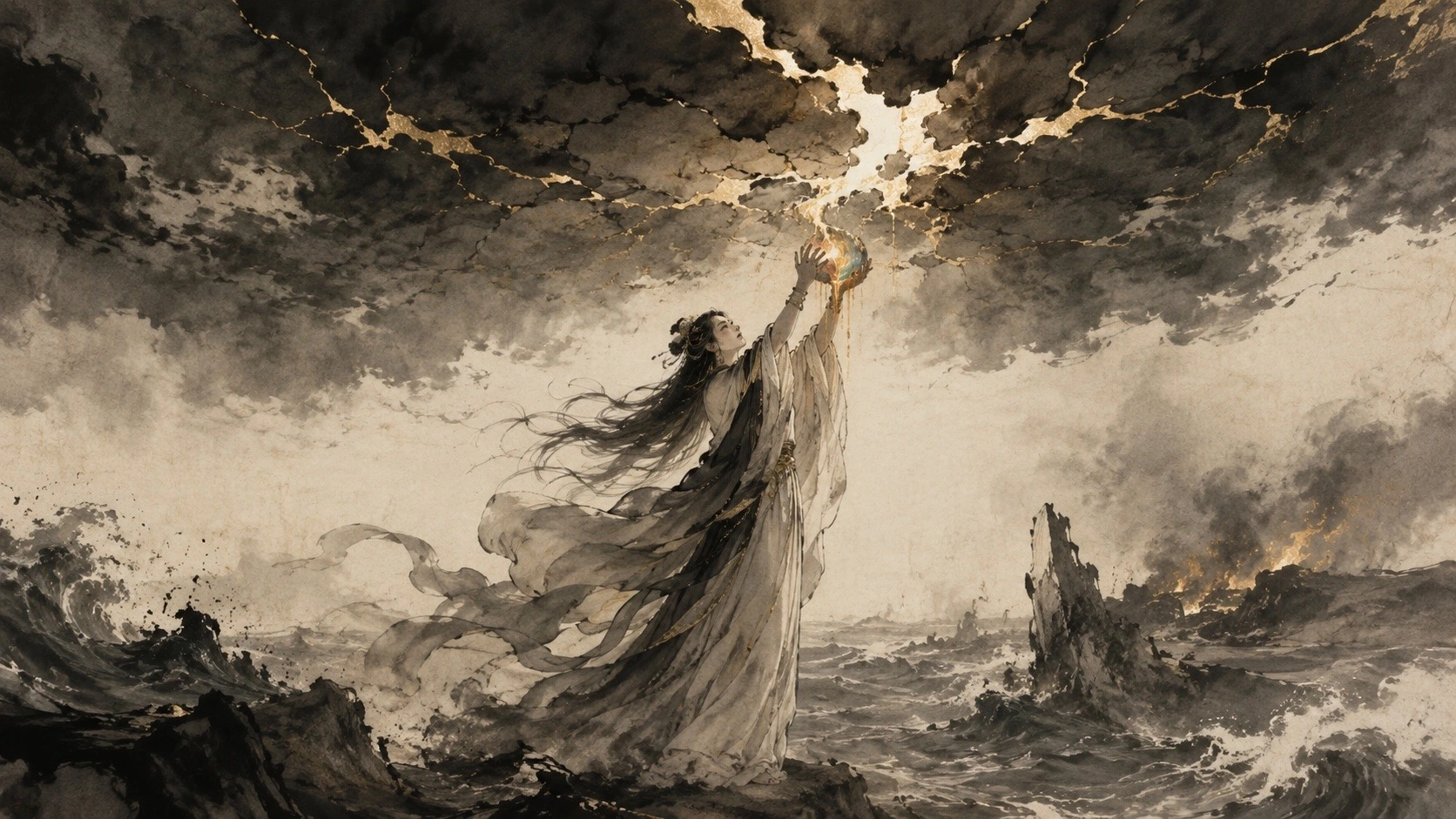
She gathered stones of five different colors and melted them together. Using the glowing material, she sealed the opening in the sky and repaired the damage above the earth.
This act is known as Nüwa Mends the Sky, or 女娲补天 — Nǚwā Bǔtiān.
The image of a goddess standing beneath a shattered sky, melting stones while fire and water destroy the world around her, became one of the most powerful scenes in Chinese mythology.
Nüwa was not fighting for a throne or attempting to defeat another god. She was repairing a world that could no longer protect itself.
The Meaning of the Five-Colored Stones
The five-colored stones are the most recognizable objects in the story.
Some later interpretations connect their colors with the Five Elements of traditional Chinese thought:
- wood;
- fire;
- earth;
- metal;
- water.
Together, these forces represent different parts of the natural world. By combining the stones, Nüwa symbolically restores harmony between elements that had fallen out of balance.
The stones can also be understood more simply. Each color is different, but Nüwa needs all of them to repair the sky. The world cannot be restored through one force alone.
In later Chinese art and literature, the five-colored stones became symbols of transformation, healing, and the ability to rebuild something that appeared permanently broken.
Rebuilding the Pillars of Heaven
Repairing the surface of the sky was not enough.
The four great supports holding Heaven above the earth had also collapsed. Without them, the sky could fall again.
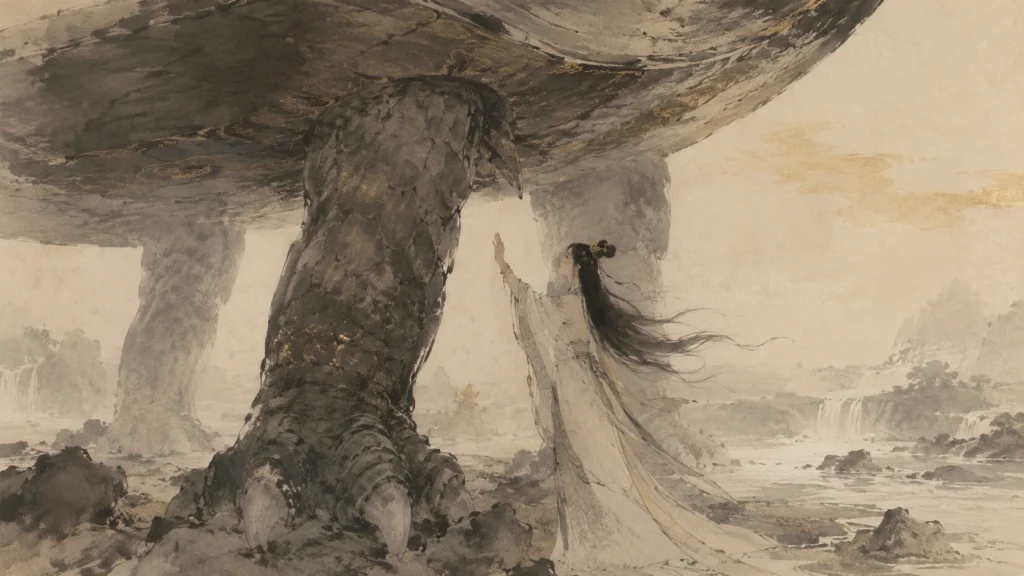
Nüwa cut off the legs of a giant tortoise and used them as new pillars at the four corners of the world. The tortoise was an ancient symbol of strength, stability, endurance, and long life, making it a fitting creature to support the restored heavens.
She then killed a black dragon that was terrorizing the land and burned reeds, gathering their ashes to control the rising floodwaters.
The Huainanzi describes the result clearly: the sky was repaired, the four corners were restored, the waters dried, dangerous creatures were defeated, and innocent people survived. (Chinese Text Project)
The world had not simply been patched together. Its order had been rebuilt.
Why Is the Sky Still Tilted?
Some later versions claim that Nüwa could not restore the world perfectly.
The legs used as the new pillars were not equal in length. Because of this, Heaven remained tilted toward the northwest, while the earth leaned toward the southeast.
The myth was later used to explain why the sun, moon, and stars appear to travel westward across the sky and why many of China’s great rivers flow toward the east or southeast.
This was not intended as a scientific explanation in the modern sense. It was a mythological way of connecting the shape of the natural world with a much older cosmic disaster.
The earth survived, but it continued to carry the marks of what had happened.
What Happened to Nüwa After She Repaired Heaven?
Chinese mythology does not preserve one universally accepted ending for Nüwa.
Different ancient traditions describe what happened to her after her great work was completed.
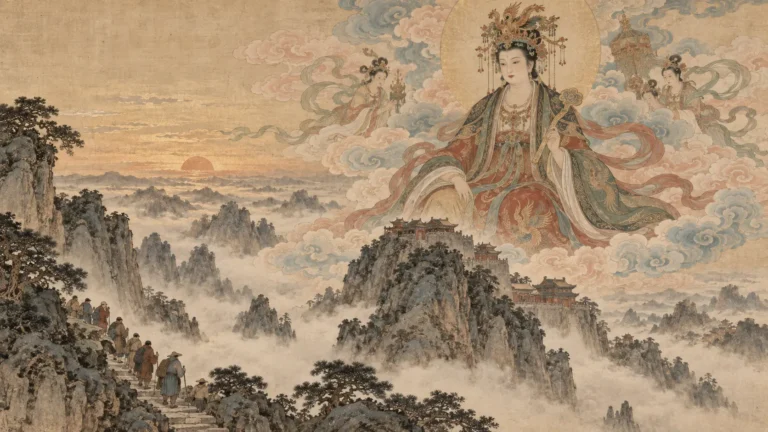
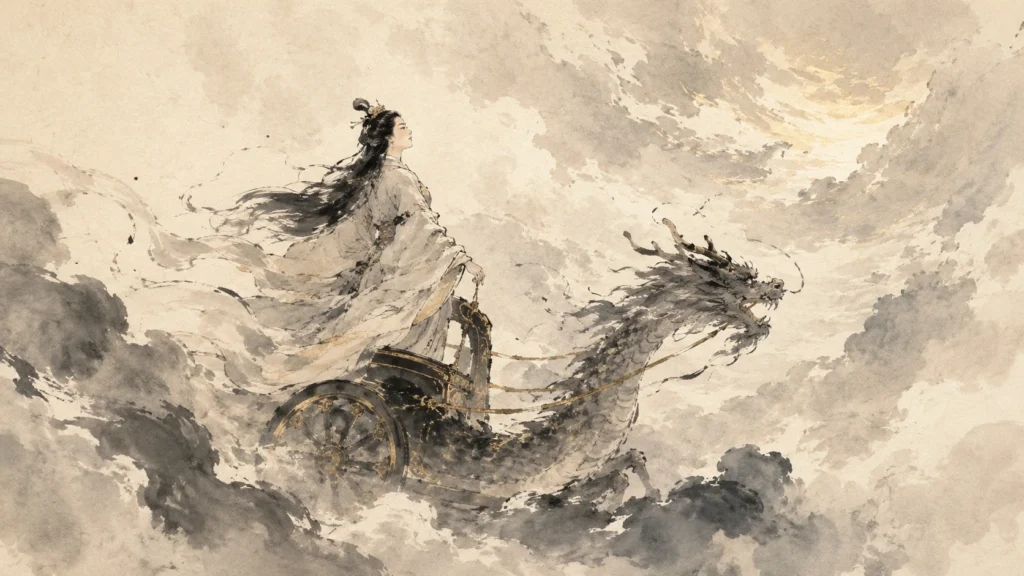
The Huainanzi describes Nüwa rising into the highest parts of Heaven after restoring the world.
She travelled in a thunder chariot led by Yinglong, the Responding Dragon. Mythical serpents and dragons accompanied her as she passed through the realm of spirits and ascended to the Nine Heavens.
There, she appeared before the heavenly ruler and rested in peace.
Despite saving the world, Nüwa did not boast about what she had achieved. The text presents her as a figure whose greatness came from acting in harmony with the natural order rather than seeking recognition. (Chinese Text Project)
Nüwa’s Body Became Ten Gods
Another strange and much darker tradition appears in the Shanhaijing, also known as the Classic of Mountains and Seas.
It states that Nüwa’s intestines transformed into ten gods who lived in the wilderness of Liguan.
The surviving passage does not explain exactly how or why this transformation occurred. It also does not clearly describe Nüwa dying in the way a normal human would.
Instead, her body appears to become a new form of divine life.
This version reflects an ancient idea found in several creation myths: the body of a powerful being does not disappear after death or transformation. It becomes part of the world and gives birth to something new. (Chinese Text Project)
Neither ending should be treated as the single official conclusion to Nüwa’s story. Chinese mythology developed through different texts, regions, and periods, allowing several traditions to exist beside one another.
What Does Nüwa Mending the Sky Symbolize?
The myth of Nüwa mending the sky is ultimately a story about responsibility.
Nüwa had already created humanity, but her role did not end with creation. When the world became dangerous, she returned to protect the lives she had brought into existence.
Her actions represent:
- restoring order after chaos;
- protecting the weak;
- repairing damage instead of abandoning it;
- bringing opposing natural forces back into balance;
- accepting responsibility for what one has created.
Nüwa does not prevent the disaster from happening. She appears after the damage has already been done.
That is what gives the story its lasting power.
The myth does not promise that the world will never break. It shows that even after Heaven falls, someone can choose to rebuild it.
The Goddess Who Refused to Abandon Humanity
Nüwa is remembered not only because she created human life but because she chose to protect it.
She stood beneath a broken sky, gathered what remained, and restored the balance between Heaven and Earth.
Some traditions say she later ascended into the Nine Heavens. Others claim that part of her body transformed into ten new gods. The details change, but the meaning remains.
Nüwa left the world alive.
Her story became a reminder that creation alone is not enough. What we create must also be protected, repaired, and allowed to continue.