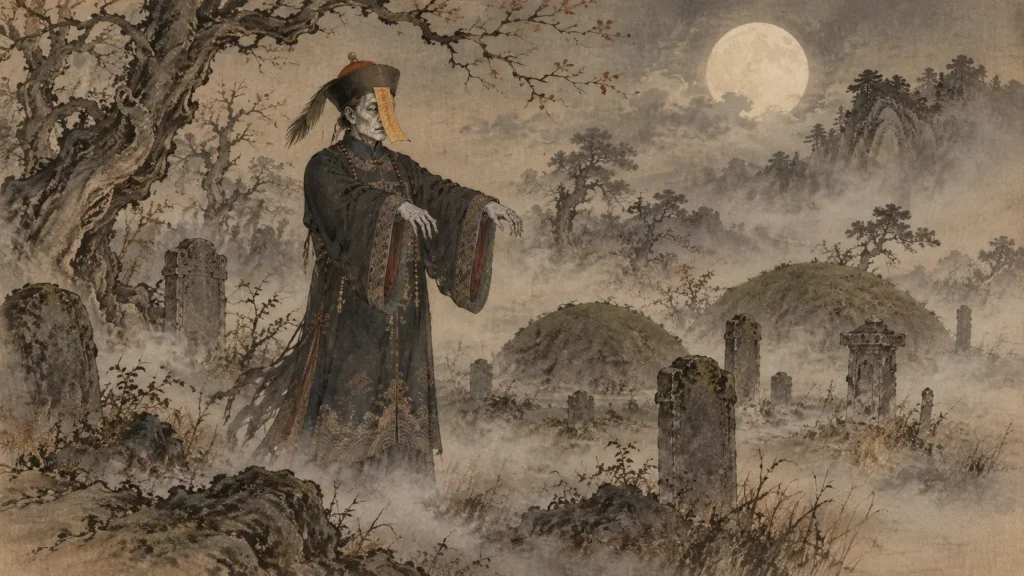
A dead man stands upright.
His body is stiff. His arms refuse to bend.
Then he moves.
Not with the slow walk of a modern zombie, but with sudden, unnatural motion through the darkness.
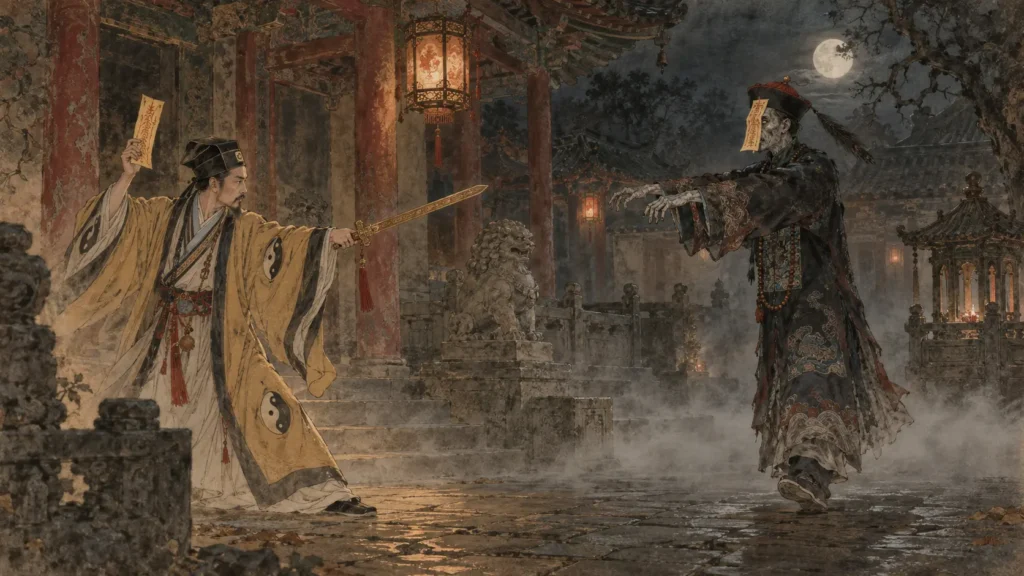
Today, almost everyone recognizes this creature by the same image: pale skin, old Chinese robes, a yellow talisman across the forehead and a rigid hopping gait.
This is the jiangshi (僵尸 / 殭屍, jiāngshī), one of the most recognizable undead figures in Chinese folklore.
It is often called the Chinese hopping vampire.
But that name tells only part of the story.
Jiangshi Quick Facts
| Chinese | 僵尸 / 殭屍 |
| Pinyin | Jiāngshī |
| Literal meaning | Stiff corpse |
| Type | Reanimated or unnaturally active corpse |
| Tradition | Chinese folklore and supernatural literature |
| Famous modern image | Rigid hopping corpse with arms extended |
| Common English name | Chinese hopping vampire |
| Important literary period | Qing dynasty |
| Major modern influence | Hong Kong jiangshi cinema |
What Is a Jiangshi?
The simplest definition is hidden inside the name itself.
Jiangshi literally means a stiff or rigid corpse.
Unlike a normal ghost, the jiangshi is defined by the body.
A dead body has failed to remain peacefully dead.
That distinction matters because modern English descriptions often force the creature into familiar categories such as vampire or zombie.
Neither comparison is perfect.
The jiangshi belongs to its own Chinese tradition of dangerous corpses, strange deaths and supernatural disruption.
And historically, there was never just one fixed version.
Jiangshi in Qing Dynasty Folklore
Long before Hong Kong movies created the famous hopping monster, strange animated corpses appeared in Chinese supernatural literature.
One of the richest examples is Yuan Mei’s eighteenth-century collection Zibuyu (子不语), a Qing dynasty compilation of stories about ghosts, strange creatures and supernatural events. Its contents include several tales explicitly involving jiangshi, including stories of a corpse seeking food, a flying corpse and an encounter with a newly formed jiangshi. Wikisource
The stories are surprisingly varied.
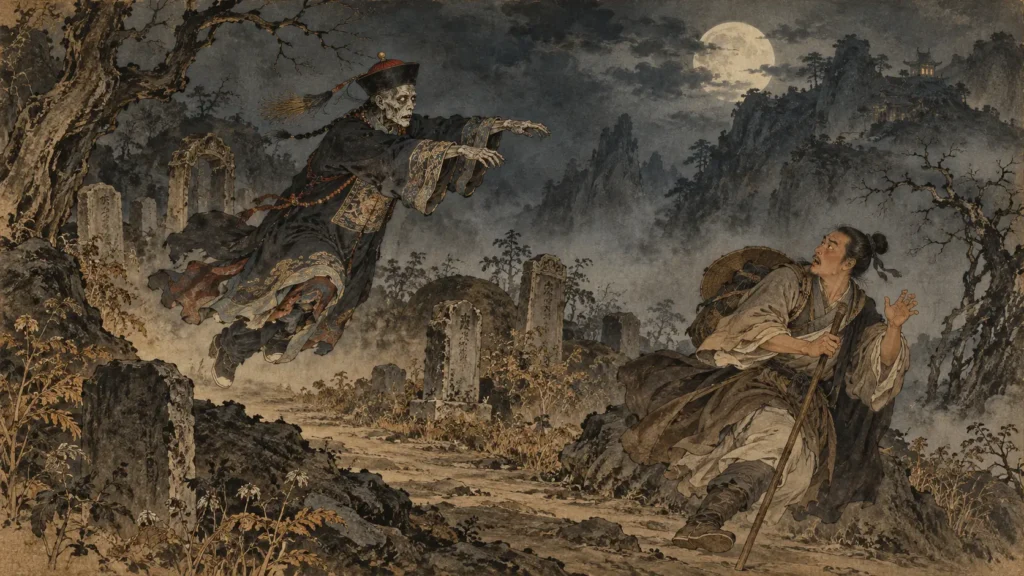
In one, a traveler encounters a pale figure that comes leaping toward him from among old graves.
In another, a jiangshi leaves its coffin at night in search of sustenance.
And in the story known as Flying Jiangshi, a corpse is described as taking to the air and attacking children. cngwzj.com
That variation is important.
There was no single ancient rulebook saying every jiangshi must dress the same, move the same way and have exactly the same weaknesses.
Much of that familiar consistency came later.
Why Does the Jiangshi Hop?
The hopping movement is real enough to have roots in older storytelling: Yuan Mei’s account already describes a jiangshi approaching through leaps.
But the perfectly rigid, arms-outstretched hopping corpse recognized around the world today is much more strongly associated with modern popular culture.
Another tradition often connected with the image comes from Hunan, particularly stories about transporting the dead back toward their home regions for burial.
These stories became associated with corpses travelling at night under supernatural or ritual control.
The connection should be treated carefully.
It is better to understand Xiangxi corpse-driving traditions as one strand that fed the later image, rather than claim that historians have proven a single practical custom created the jiangshi legend. Hong Kong Film Archive likewise describes the films as drawing on Hunan folklore about walking corpses and combining it with other influences. Film Archive
Is a Jiangshi a Vampire or a Zombie?
Not exactly.
“Chinese hopping vampire” is a useful English nickname because it immediately communicates an undead creature that threatens the living.
But a jiangshi is not simply Dracula in Chinese clothing.
Traditional accounts focus on a dangerous animated corpse rather than the classic European vampire’s identity, immortality and blood-drinking mythology.
Modern jiangshi stories often describe the creature attacking or draining the vital force of living people, while older accounts vary far more widely in what the corpse actually does.
The zombie comparison is also incomplete.
A jiangshi is physically dead and animated, but the surrounding beliefs, ritual imagery and literary history are distinctly Chinese.
The best term is still the original one:
jiangshi — the stiff corpse.
Taoist Priests, Talismans and Jiangshi
One of the most famous images of the jiangshi is the strip of yellow ritual paper attached to its forehead.
Another is the Daoist priest using spells, ritual tools and supernatural knowledge to control the corpse.
These ideas draw on a wider Chinese religious world in which ritual specialists, talismans and proper handling of the dead mattered.
But we should not automatically assume that every rule seen in a modern jiangshi movie represents ancient folklore.
The complete package familiar today — the costume, rigid hopping, forehead talisman, comic ritual battles and elaborate countermeasures — owes an enormous amount to twentieth-century cinema.
That separation between older corpse lore and modern genre rules is essential if we want to understand the creature rather than simply repeat movie conventions.
How Mr. Vampire Created the Modern Jiangshi
The turning point came in 1985.
Directed by Ricky Lau and produced by Sammo Hung, Mr. Vampire became one of Hong Kong’s major box-office successes of the year and triggered a wave of similar supernatural films. Film Archive
The movie combined horror, comedy, martial arts and Chinese ritual imagery.
Its Daoist priest battles the undead.
Characters try to avoid detection by holding their breath.
Corpses move with the now-famous rigid physical style.
The result was so influential that this cinematic version became, for many people, the jiangshi.
An academic study published in The Journal of Popular Culture describes this Hong Kong tradition specifically in terms of “hopping vampire zombies” and examines how cinema carried Chinese folklore into a modern popular-cultural form. Wiley Online Library
The monster people recognize today is therefore not fake folklore.
But it is layered folklore.
Old corpse stories came first.
Regional traditions added more.
Cinema then transformed those pieces into an unforgettable icon.
Jiangshi vs Ghosts and the Chinese Underworld
A jiangshi should also not be confused with an ordinary dead soul.
In stories about the Chinese underworld, the dead may face judgment and pass through a supernatural system beyond the human world.
A jiangshi represents a different horror.
The problem is still here.
The corpse itself has not remained where it belongs.
That makes the jiangshi especially unsettling.
A ghost can disappear into darkness.
A jiangshi still has a face.
A body.
A grave.
And somewhere, someone expected that body to remain dead.
Other traditions describe souls passing toward judgment, rebirth, or figures such as Meng Po, rather than remaining physically active as a corpse.
Why the Jiangshi Still Matters
It is easy to laugh at a hopping corpse.
Hong Kong filmmakers often wanted audiences to do exactly that.
But underneath the comedy is an older fear.
Death is supposed to create a boundary.
The living remain here.
The dead leave.
The jiangshi breaks that boundary.
That is why it works equally well as folklore, horror and comedy.
The modern hopping vampire may be partly a creation of cinema, but the idea behind it is much older:
something has gone wrong with the dead.
And now the body is moving again.
References
Yuan Mei — Zibuyu (子不语 / What the Master Would Not Discuss)
A major Qing-dynasty supernatural-story collection containing multiple jiangshi narratives, including Flying Jiangshi and stories of active corpses. Wikisource
Read Zibuyu on Wikisource
Marc L. Moskowitz — “Hopping Vampire Zombies: Hong Kong Cinema Brings Chinese Folklore to the Present”
Peer-reviewed research in The Journal of Popular Culture on the relationship between Chinese folklore and modern jiangshi cinema. Wiley Online Library