A baby is crying somewhere on Mount Gouwu.
But there is no child.
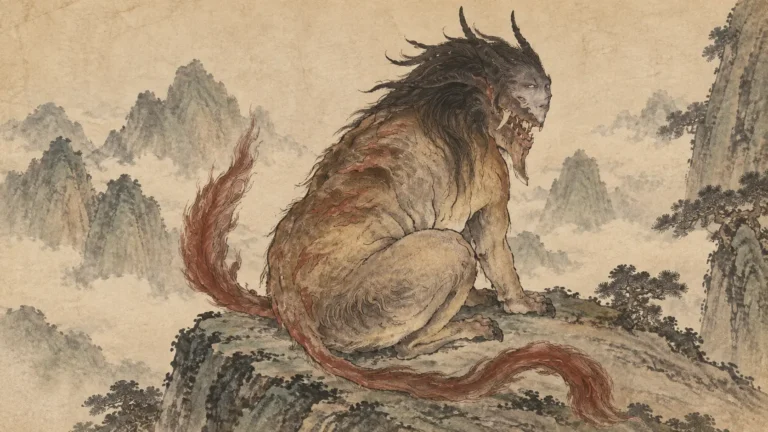
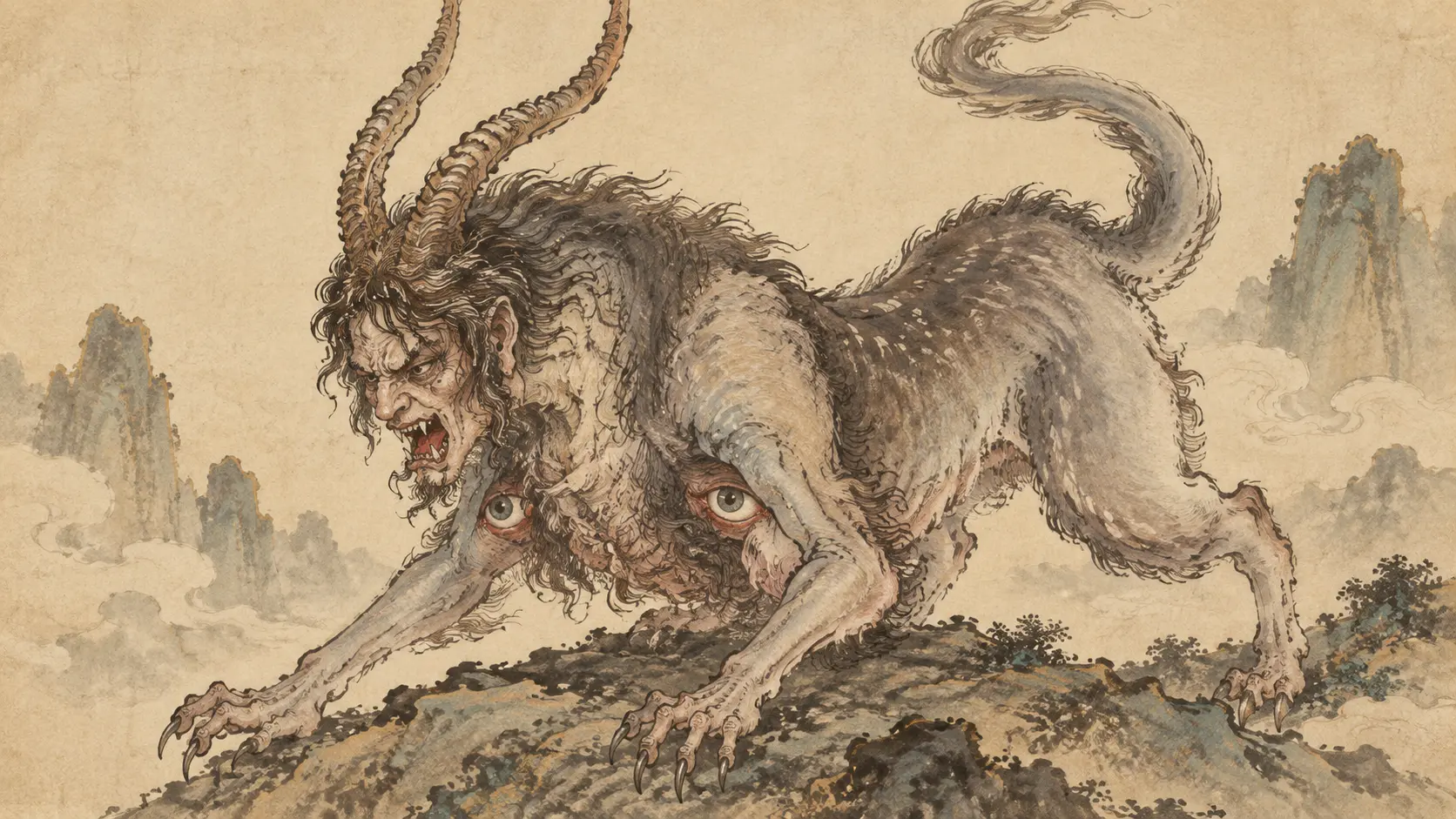
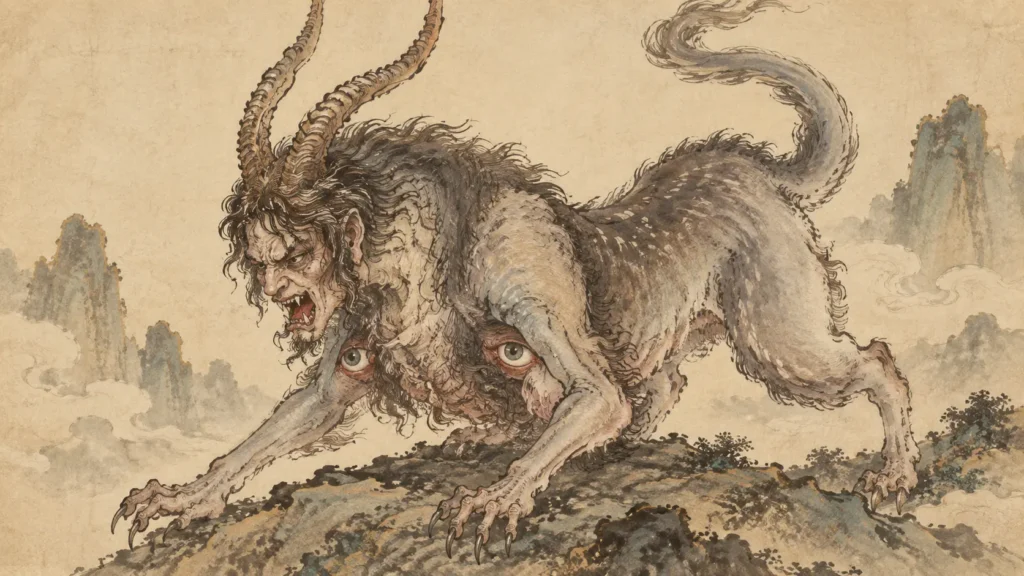
What emerges from the mountain has the body of a sheep and the face of a human. Its teeth belong to a tiger. Its limbs end in human-like claws.
And its eyes are not on its face.
They stare from beneath its arms.
This is Paoxiao (狍鸮 / 狍鴞, Páoxiāo), one of the strangest man-eating beasts recorded in the Shan Hai Jing — and a creature later writers would connect to one of the most famous monsters in Chinese tradition:
Taotie.
Paoxiao at a Glance
| Chinese name | 狍鸮 / 狍鴞 |
| Pinyin | Páoxiāo |
| Primary source | Shan Hai Jing 山海經 |
| Section | Northern Mountain Classic 北山經 |
| Home | Mount Gouwu 鈎吾之山 |
| Body | Sheep-like |
| Face | Human |
| Eyes | Beneath the armpits |
| Teeth | Like a tiger |
| Claws | Human-like |
| Cry | Like an infant |
| Diet | Humans |
| Later connection | Identified with Taotie by Guo Pu |
What Is Paoxiao in Chinese Mythology?
Paoxiao is a man-eating creature from the Shan Hai Jing described as having a sheep-like body, human face, eyes beneath its armpits, tiger teeth and human-like claws. Its cry resembles a human baby. The original text calls it Paoxiao, while later commentator Guo Pu explicitly connected the beast with Taotie.
That distinction matters.
Paoxiao’s earliest surviving description is remarkably short. There is no elaborate origin story, legendary battle or list of magical powers.
The creature simply exists in the geography of the Shan Hai Jing.
And that may make it more disturbing.
What Does the Shan Hai Jing Say About Paoxiao?
The Northern Mountain Classic places Paoxiao on Mount Gouwu (鈎吾之山).
The mountain itself is described before the beast appears: jade is found on its upper slopes and copper below.
Then comes Paoxiao.
The original text describes:
其狀如羊身人面,其目在腋下,虎齒人爪,其音如嬰兒
In straightforward English:
It has the body of a sheep and the face of a human. Its eyes are beneath its armpits. It has tiger teeth and human claws. Its voice sounds like an infant.
The passage ends with three brutal characters:
是食人 — it eats humans.
The page from your book preserves exactly these defining features and adds a useful modern explanation of the creature’s anatomy and its later relationship with Taotie.
Why Are Paoxiao’s Eyes Beneath Its Arms?
The Shan Hai Jing gives no explanation.
That is important because modern retellings often try to assign elaborate symbolism to every abnormal feature.
We do not need to.
The original image is already powerful enough.
Paoxiao combines familiar forms in impossible positions:
a sheep’s body,
a human face,
a predator’s teeth,
human-like hands,
and eyes where eyes should never exist.
The result is not simply a hybrid animal. It is a body assembled from recognizable parts that no longer obey normal anatomy.
That is exactly the kind of visual impossibility that makes the Shan Hai Jing bestiary so memorable.
Does Paoxiao Use a Baby’s Cry to Lure People?
We cannot confirm that from the original passage.
The text says Paoxiao’s voice sounds like an infant.
It does not say that the creature deliberately imitates babies to lure travelers into a trap.
Some modern retellings add that interpretation.
For Becoming Konstantin, I would not present it as ancient fact.
The source-backed version is disturbing enough:
somewhere on Mount Gouwu, a human-eating beast produces the unmistakable sound of a crying child.
Is Paoxiao the Same as Taotie?
This is where the story becomes much more interesting.
The original Shan Hai Jing names the creature Paoxiao.
But centuries later, the scholar Guo Pu (郭璞, 276–324) commented on the passage and connected Paoxiao directly with Taotie (饕餮).
His commentary describes the creature as excessively greedy and associates it with the Taotie known from older traditions and ritual vessels. Later annotated editions preserve this identification explicitly.
This is why the book you sent describes Paoxiao as a prototype or earlier form associated with Taotie.
But we should not flatten every historical layer into one.
A better way to understand the relationship is:
Shan Hai Jing → Paoxiao
Guo Pu’s commentary → Paoxiao identified with Taotie
Later tradition → Taotie increasingly associated with insatiable appetite and greed
That chronology is much more accurate.
Taotie and the Four Evils
The Zuo Zhuan gives us another important layer.
Its Taotie is connected with an unworthy descendant of the Jinyun clan, characterized by an appetite that can never be satisfied — not only for food, but also for wealth and possessions.
The text places Taotie alongside Hundun, Qiongqi and Taowu, forming the famous group later known as the Four Evils / Four Perils (四凶).
Notice the difference.
The Shan Hai Jing gives us a bizarre animal body.
The Zuo Zhuan gives us a tradition centered on moral corruption and limitless greed.
Guo Pu helps connect these traditions later.
That is much more interesting than simply saying “Paoxiao is Taotie” and moving on.
Why Is Taotie Shown as a Head Without a Body?
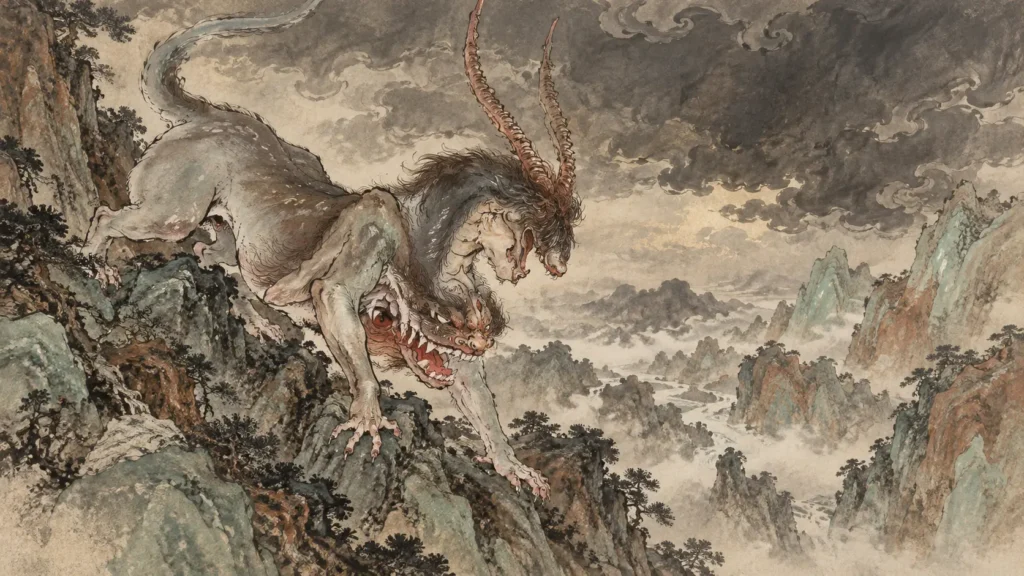
The book page you sent also mentions one of the strangest Taotie traditions: the idea of a creature reduced to a head without a body because of its endless appetite.
An ancient source behind that tradition is the Lüshi Chunqiu.
It describes Taotie imagery on Zhou ritual vessels as having a head but no body, explaining the image through a moral lesson about destructive excess: the creature devours, yet ultimately the harm reaches itself.
This helps explain why later Chinese tradition could use Taotie as a metaphor for people who are endlessly greedy or gluttonous.
But another distinction is important.
Modern museums use the term taotie for the striking frontal animal masks found on Shang and Zhou ritual bronzes. The Metropolitan Museum of Art describes these as stylized animal masks characterized especially by prominent eyes, often with horns, jaws or fangs.
We should therefore avoid claiming that every ancient bronze “taotie mask” is literally a portrait of the Paoxiao described in the Shan Hai Jing.
The traditions overlap.
They are not automatically identical.
What Did Paoxiao Really Look Like?
If we follow the earliest description rather than modern fantasy artwork, we have only a handful of fixed features:
sheep-like body
human face
eyes beneath the arms
tiger teeth
human-like claws
Everything else is interpretation.
That is why the illustration in your book is useful as a visual reference, but our own artwork should still be based first on the written description rather than copying a modern artist’s design.
Paoxiao should look strange because of what the ancient source says.
Not because we add random dragon horns, armor or fantasy features.
Why Paoxiao Is More Important Than It Looks
At first, Paoxiao seems like another short entry in the endless bestiary of the Shan Hai Jing.
But follow the creature forward through Chinese literature and something much larger appears.
A man-eating beast on a mountain becomes associated with Taotie.
Taotie becomes a language of limitless appetite.
Ancient texts connect that appetite with greed, moral failure and self-destruction.
And its name becomes attached to some of the most recognizable animal-mask imagery in early Chinese bronze art.
That is why Paoxiao deserves more than a paragraph in a monster list.
Its original story may be short.
Its afterlife is enormous.
References
Primary source — Shan Hai Jing: Northern Mountain Classic
The original Mount Gouwu passage describing Paoxiao’s anatomy, infant-like cry and man-eating nature.
Chinese Text Project – Northern Mountain Classic