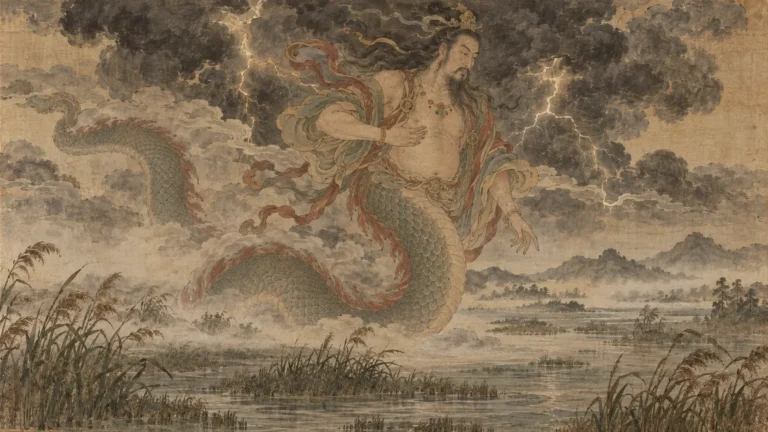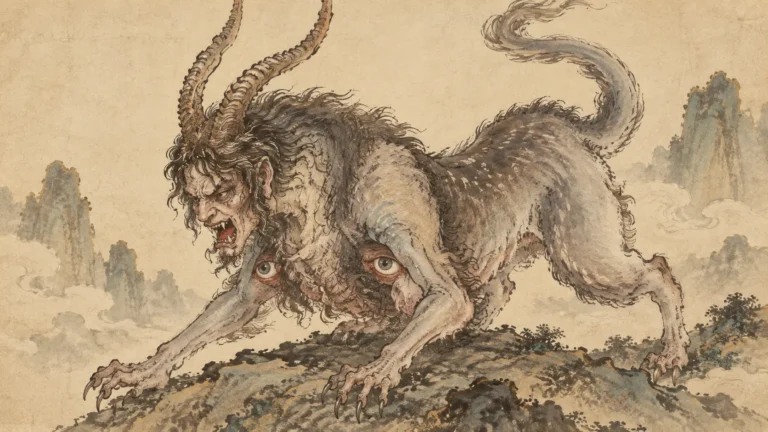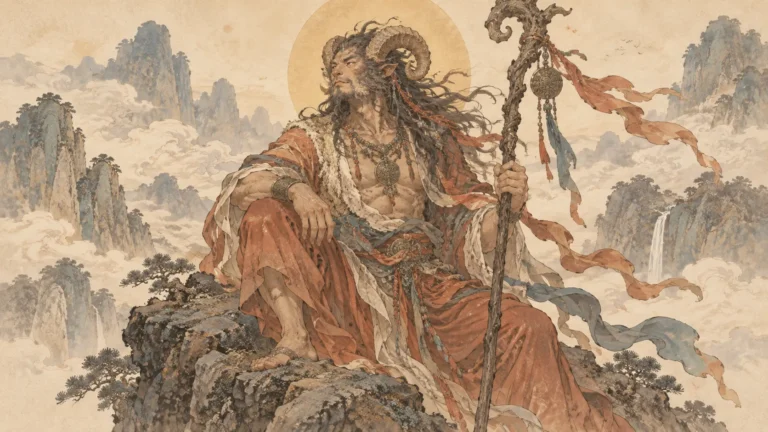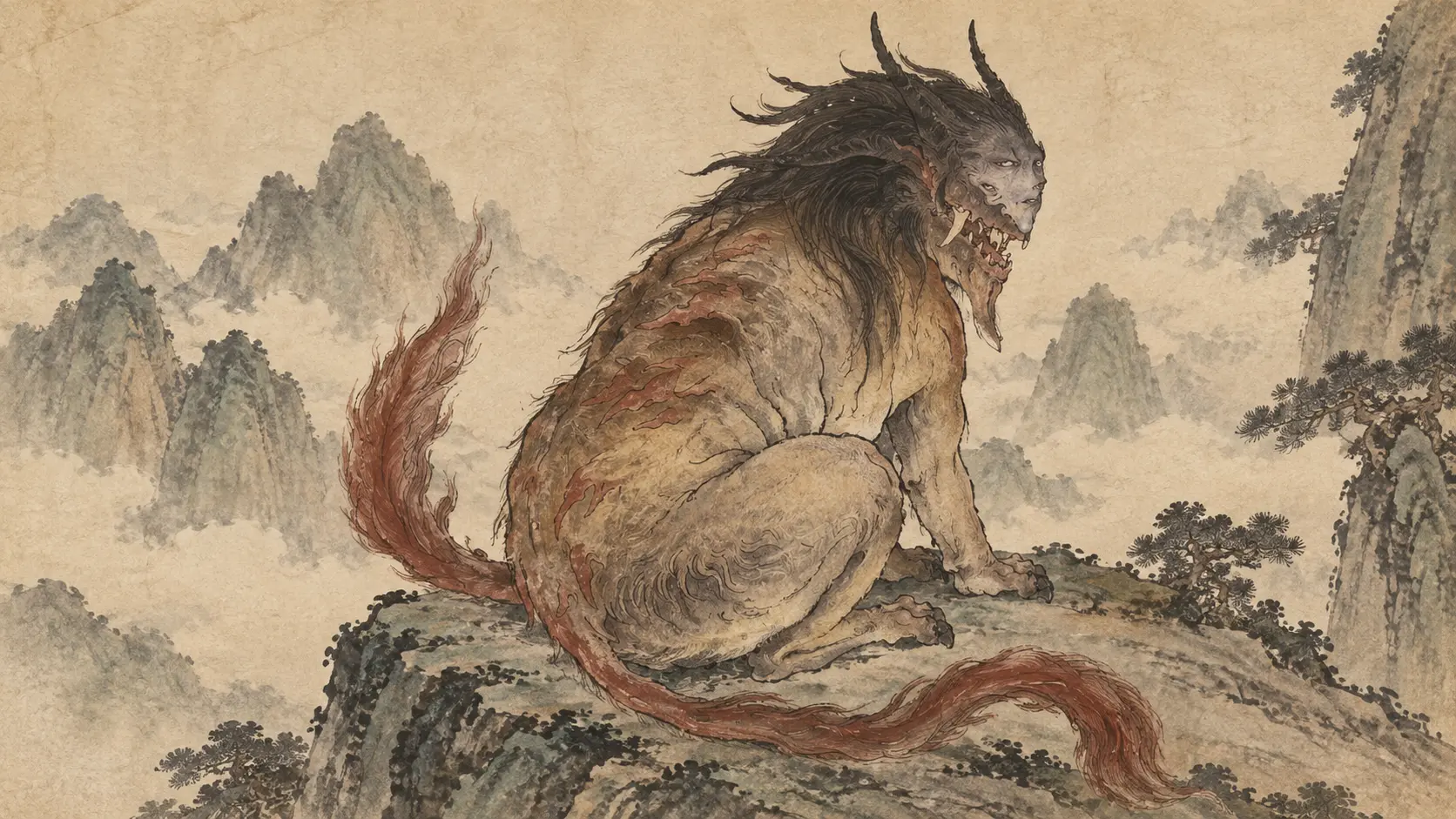
A baby cries somewhere in the mountains.
There should be nothing unusual about that sound.
Except there is no child.
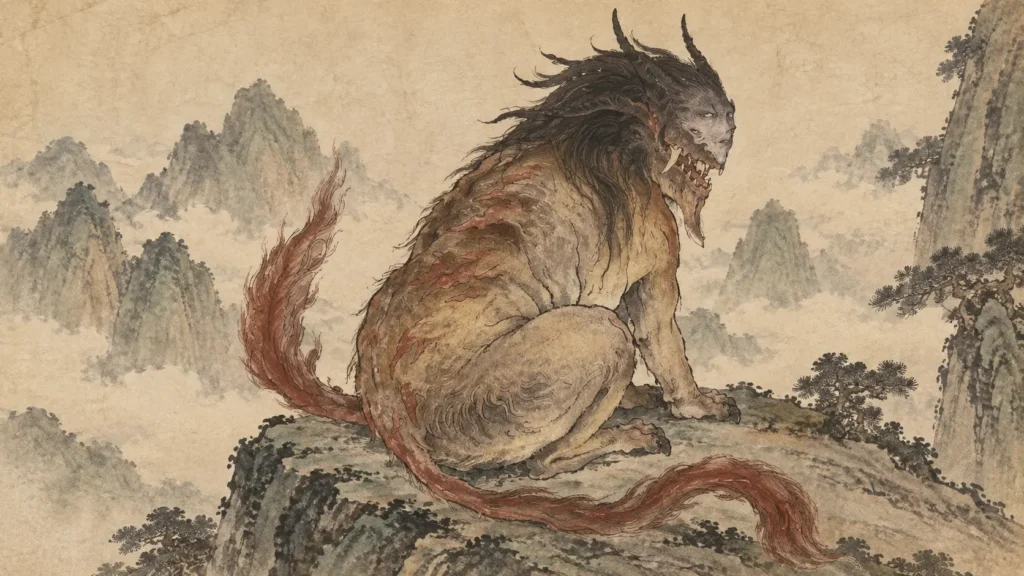
Moving through the wilderness is a yellow beast with the body of a pig, the face of a human and a blood-red tail.
It eats snakes.
It eats insects.
And it eats people.
Its name is Heyu (合窳, Héyǔ).
According to the Shan Hai Jing, seeing it means something even worse is coming:
a great flood.
Heyu at a Glance
| Chinese name | 合窳 |
| Pinyin | Héyǔ |
| Source | Shan Hai Jing 山海經 |
| Section | Eastern Mountain Classic 東山經 |
| Habitat | Mount Yan / 剡山 |
| Body | Pig-like |
| Face | Human |
| Color | Yellow body |
| Tail | Red |
| Cry | Like a human infant |
| Diet | Humans, insects and snakes |
| Omen | Its appearance foretells a great flood |
What Is Heyu in Chinese Mythology?
Heyu is a man-eating beast from the Shan Hai Jing, described as having a pig-like body, a human face, yellow skin and a red tail. Its cry sounds like a human baby. It eats people, insects and snakes, and its appearance is said to foretell a great flood across the realm.
Unlike many famous Chinese mythological creatures, Heyu does not have a long heroic story attached to it.
Almost everything we know comes from a remarkably compact passage.
And that makes the original description especially important.
What Does the Shan Hai Jing Say About Heyu?
The Eastern Mountain Classic describes a mountain called 剡山, rich in gold and jade.
There lives a beast:
“其状如彘而人面,黄身而赤尾,其名曰合窳,其音如婴儿。”
In straightforward English:
It resembles a pig but has a human face. Its body is yellow and its tail red. It is called Heyu, and its voice sounds like an infant.
The text then adds the details that transform an unusual animal into something genuinely disturbing.
Heyu eats humans.
It also eats insects and snakes.
And when it appears:
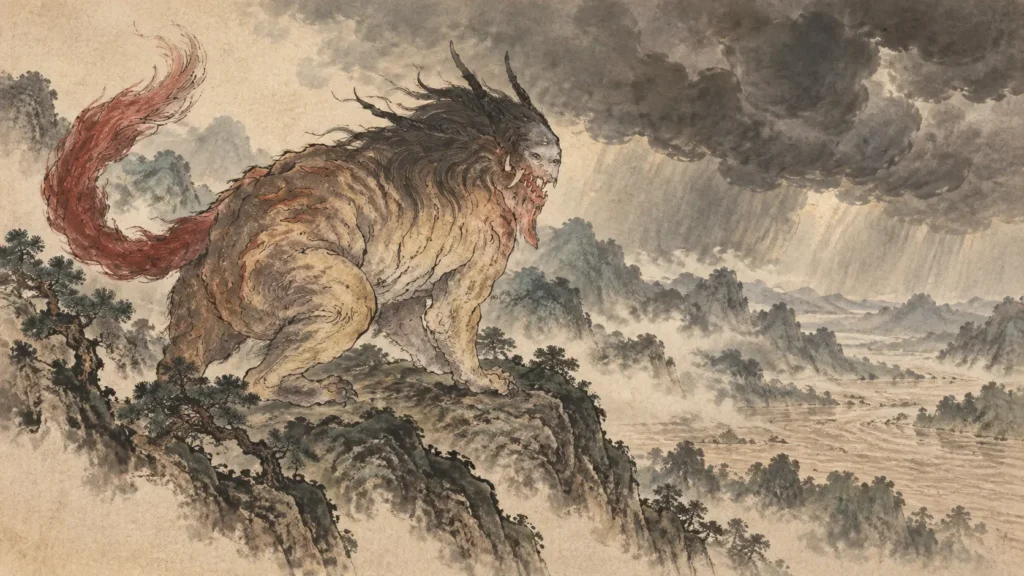
“见则天下大水” — a great flood comes upon the world.
There is no battle with a legendary hero.
No explanation for how Heyu was born.
No ancient story about someone killing it.
The text simply records the creature as though a traveller might actually encounter it.
That detached tone is part of what makes the Shan Hai Jing so strange.
Why Does Heyu Sound Like a Crying Baby?
Heyu’s infant-like cry is frightening, but it is not unique within the Shan Hai Jing.
Several dangerous creatures in the text are described as producing sounds resembling human babies.
The motif appears with creatures such as the horned Gudiaoniao, the human-faced Mafu, and the similarly named Yayu.
The original text does not explain why.
So we should be careful not to invent a hidden symbolic meaning.
Perhaps the sound made these creatures uncanny because something visibly nonhuman produced an unmistakably human voice.
Perhaps it functioned as a warning motif.
But those are interpretations.
What the source actually tells us is simpler:
a traveller could hear what sounded like an infant and discover that the sound came from something capable of eating humans.
That alone is disturbing enough.
Why Does Heyu Bring a Great Flood?
Heyu belongs to a recurring category within the Shan Hai Jing: creatures whose appearance predicts a disaster or major event.
Some creatures foretell drought.
Others disease.
Others abundance.
Heyu belongs to the flood omens.
The wording is direct:
when Heyu appears, there will be great water beneath Heaven.
Later Chinese compilers continued preserving this association. Collections discussing flood omens placed Heyu alongside other strange creatures whose appearances predicted destructive water events.
But the ancient text never explains how Heyu causes the flood.
That distinction matters.
It does not explicitly say the beast summons rain or controls rivers.
It says its appearance is an omen.
Heyu may therefore be better understood as a creature connected with catastrophe rather than a water deity commanding it.
Is Heyu the Same Creature as Yayu?
No.
Their names can cause confusion, especially in English transliteration, but Heyu (合窳) and Yayu (窫窳) are separate creatures.
The Shan Hai Jing describes Yayu elsewhere as a beast resembling a cow with a red body, human face and horse feet. Like Heyu, its voice sounds like a baby and it eats humans.
Heyu is different:
pig-like body → human face → yellow body → red tail → flood omen.
This is exactly why preserving the Chinese characters matters.
合窳 ≠ 窫窳.
Two monsters.
Two descriptions.
Two separate entries.
How Did Later Writers Describe Heyu?
Centuries after the Shan Hai Jing, commentators continued discussing the creature.
The famous scholar Guo Pu (郭璞) glossed the pronunciation of 窳 and also composed a short poetic description of Heyu.
Later annotated editions preserve a verse describing it as pig-bodied and human-faced, emphasizing its violent appetite and connecting it with extreme yin and rain.
This later interpretation is interesting, but it should not be confused with the earliest text.
The original Shan Hai Jing gives us:
appearance → voice → diet → flood omen.
The symbolic explanation comes later.
That difference between the ancient entry and later commentary is exactly the kind of source layer worth preserving.
What Does Heyu Actually Look Like?
If we follow the written source strictly, the core anatomy is surprisingly clear:
pig-like body
human face
yellow coloration
red tail
Everything beyond that is artistic interpretation.
The illustration in the modern book version you showed me gives Heyu a much more monstrous, predatory face and mane-like features.
It looks great visually.
But for our Becoming Konstantin artwork, I would keep the creature closer to the text rather than copying a modern artist’s design.
That means recognizably pig-like anatomy first.
The horror should come from the human face, strange infant cry and unnatural colors, not from turning Heyu into a generic fantasy demon.
Why Heyu Deserves to Be Remembered
Heyu occupies only a few lines.
But those lines contain almost everything that makes the Shan Hai Jing unforgettable.
A familiar animal becomes wrong.
A human face appears where it should not.
A child’s voice comes from the wilderness.
And the creature’s arrival means the landscape itself is about to change.
No elaborate origin story is necessary.
Sometimes ancient mythology creates its strongest monsters with only a description and a warning:
if you see Heyu, the water is coming.
References
Primary source: Shan Hai Jing — Eastern Mountain Classic. The surviving text gives the full description of Heyu’s anatomy, infant-like cry, diet and flood omen.