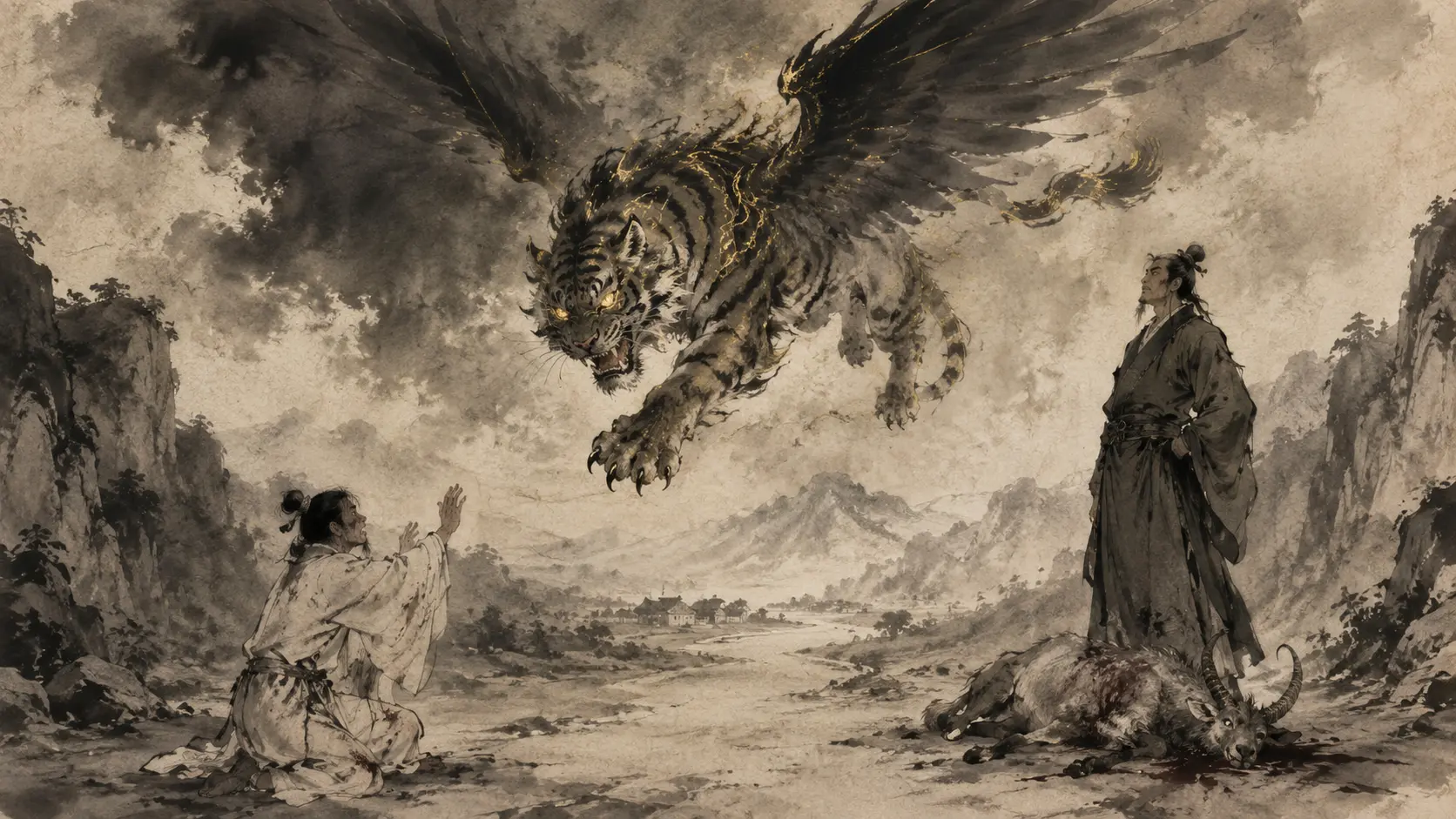
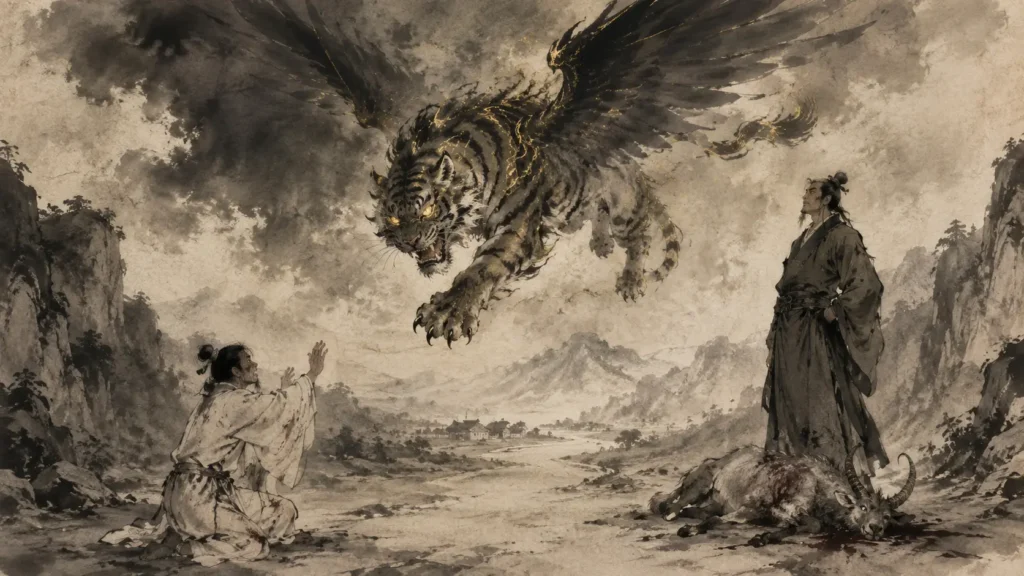
Imagine hearing two people argue on an empty road.
One is honest. The other is cruel.
Then something enormous descends from the sky—not to punish the liar, but to attack the person who was right.
That is the nightmare at the heart of Qiongqi.
Among the strange creatures of Chinese mythology, few represent such a disturbing idea. Qiongqi is not remembered only as a man-eating beast. It became the symbol of a world where morality has been reversed: loyalty is punished, wickedness is encouraged, and strength protects the wrong side.
Yet there is no single version of Qiongqi.
Ancient texts describe it as an ox covered in bristles, a winged tiger, a corrupt human figure, and a supernatural force connected with the wind. The creature changed over time, but its threatening nature remained.
What Is Qiongqi in Chinese Mythology?
Qiongqi is an ancient Chinese mythological creature whose appearance and meaning differ across classical texts.
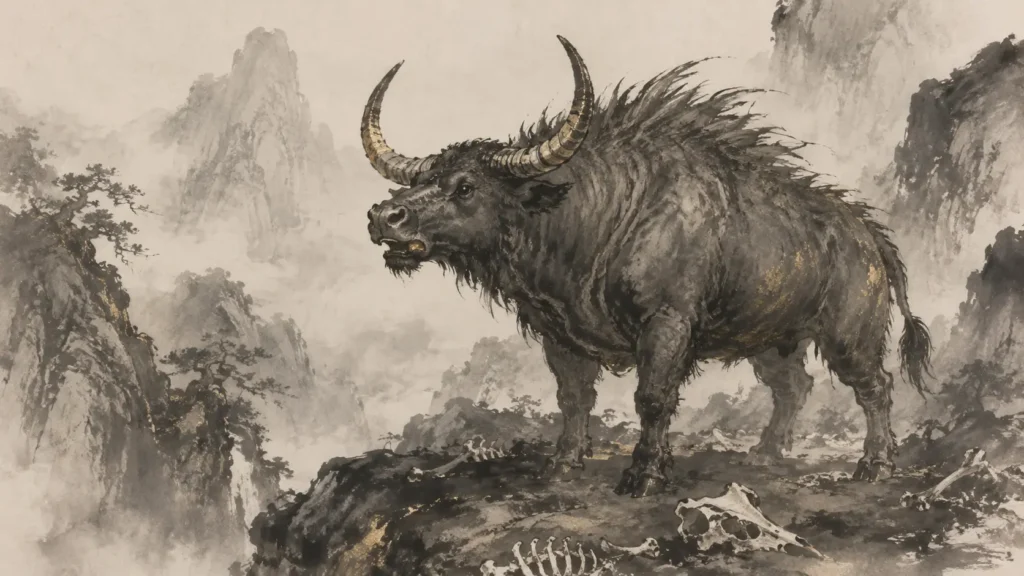
In one section of the Classic of Mountains and Seas, Qiongqi lives on Mount Gui. It resembles an ox covered in hedgehog-like bristles, makes a sound like a barking dog, and feeds on human beings.
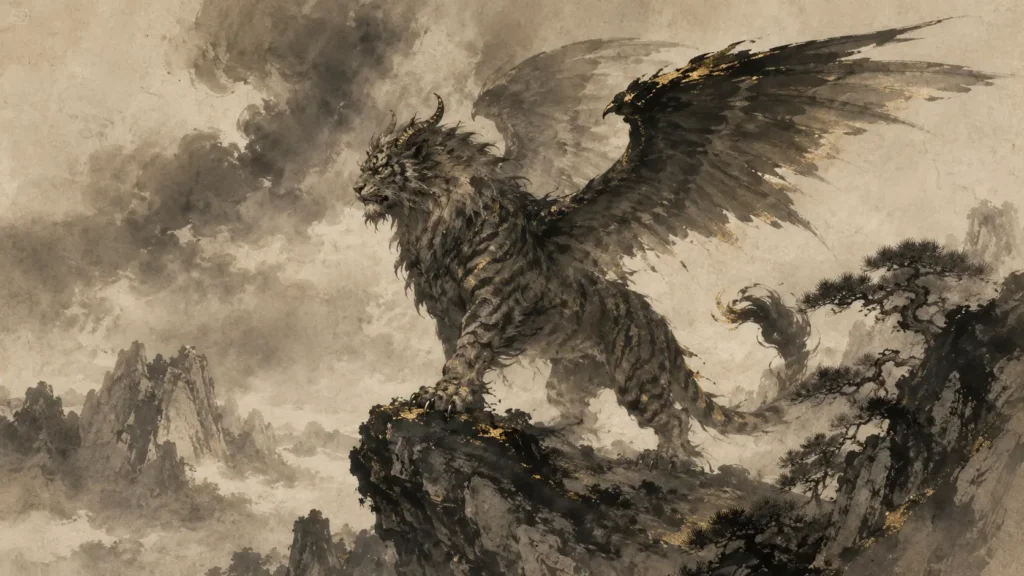
Another section of the same work describes Qiongqi as a tiger with wings. This creature also eats humans, beginning with either the head or the feet depending on the version of the passage.
These descriptions do not fit together neatly.
That does not mean one of them must be wrong. Ancient mythological creatures were not created like modern fictional characters with one official appearance and biography. Their stories developed across generations, regions, texts, and different purposes.
The familiar image of Qiongqi as a winged tiger is therefore based on an ancient source—but it is not its only authentic form.
From Mountain Beast to Moral Corruption
The Zuo Zhuan presents Qiongqi in a very different way.
Instead of describing an animal, the text speaks of an unworthy son of Shaohao. He destroys trust, abandons loyalty, praises harmful speech, gathers slander, and uses it to attack people of virtue. Because of this behaviour, the people call him Qiongqi.
This version transforms the creature from a monster that consumes bodies into something that corrupts society.
Its danger is not simply violence.
Qiongqi makes honesty weaker and deception stronger. It represents an environment where good people suffer for doing the right thing, while liars, flatterers, and betrayers are rewarded.
That kind of monster does not need claws to destroy a community.
The Beast That Chose the Wrong Side
Later traditions make this reversal of good and evil even clearer.
A description quoted from the Shenyi Jing portrays Qiongqi as a winged, tiger-like beast capable of understanding human speech.
When Qiongqi hears two people fighting, it attacks the person who is in the right. When it discovers that someone is loyal and trustworthy, it harms them. But when it encounters someone wicked, it kills an animal and presents the meat as a gift.
This is why calling Qiongqi “the beast that rewarded evil” is more than a dramatic title.
In this tradition, encouraging wrongdoing is part of its identity.
Qiongqi does not merely commit evil for its own benefit. It strengthens evil in other people.
That makes it different from Taotie, whose endless appetite represents desire without limits.
Taotie consumes because nothing is ever enough.
Qiongqi understands who deserves protection—and deliberately chooses the wrong side.
Why Does Qiongqi Have So Many Forms?
Qiongqi appears as an ox-like animal, a winged tiger, a corrupt descendant of Shaohao, and a being associated with the Guangmo wind in the Huainanzi.
These contradictions reveal how mythology evolves.
Different writers used Qiongqi for different purposes.
The Classic of Mountains and Seas places it inside a dangerous world filled with impossible animals and remote mountains.
The Zuo Zhuan uses its name to describe the destruction of loyalty and trust.
Later supernatural literature transforms that moral corruption into the behaviour of a physical monster that attacks the innocent and supports the wicked.
Its body changes, but the warning becomes clearer.
Qiongqi is what happens when intelligence, influence, or power loses its moral direction.
Qiongqi and the Four Perils
The Zuo Zhuan groups Qiongqi with Hundun, Taowu, and Taotie. Together, they became known as the Four Perils—figures associated with destructive qualities and disorder.
However, each creature represents a different danger.
Taotie is strongly associated with greed and uncontrolled appetite.
Qiongqi is connected more closely with slander, broken loyalty, corrupted judgement, and the deliberate defence of wrongdoing.
For that reason, Qiongqi deserves its own story.
The complete history and meaning of the Four Perils belong in a separate guide. Here, the important warning is simpler:
A society becomes dangerous when strength stops protecting what is right.
What We Can Take From Qiongqi
Most people imagine evil as something obvious.
A monster attacks. A villain lies. A cruel person hurts someone weaker.
Qiongqi points toward a more uncomfortable reality.
Wrongdoing becomes powerful when other people reward it.
It grows when dishonesty receives attention, cruelty earns respect, and loyalty is treated as weakness. It survives because someone laughs, remains silent, joins in, or decides that being accepted matters more than doing what is right.
Strength by itself is not a virtue.
Discipline, courage, intelligence, and physical power can protect others—but they can also serve ego, fear, or corruption.
The real question is not only whether you are strong.
It is what your strength stands beside.
That is also one of the ideas behind Warrior Training: power must be directed by judgement, restraint, and character.
Qiongqi is frightening because it does not fail to understand the difference between good and evil.
It understands.
Then it chooses evil anyway.
Reference:
- Chinese Text Project — Classic of Mountains and Seas: Western Mountains
Contains the ox-like description of Qiongqi, including its hedgehog-like fur, dog-like cry, and habit of eating humans. - Chinese Text Project — Classic of the Northern Interior of the Realm
Describes Qiongqi as a winged tiger-like creature that consumes human beings. - Chinese Text Project — Zuo Zhuan, Duke Wen, Eighteenth Year