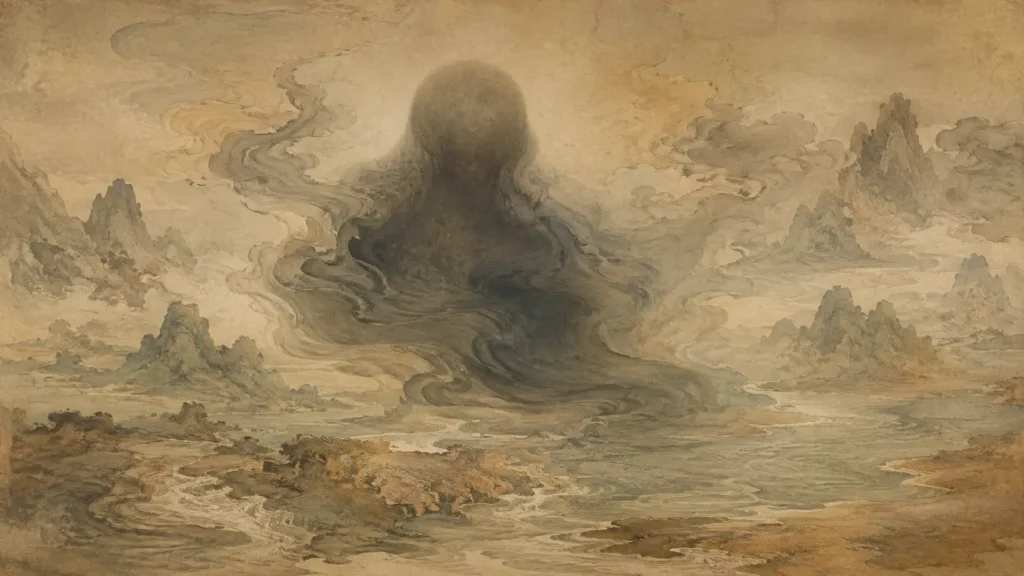
Before mountains rose.
Before the sky separated from the earth.
Before gods, humans, and the natural world existed in their familiar forms, ancient Chinese mythology imagined something completely different.
A state where everything existed together.
Not darkness.
Not emptiness.
But a mysterious, endless unity where nothing had yet been divided.
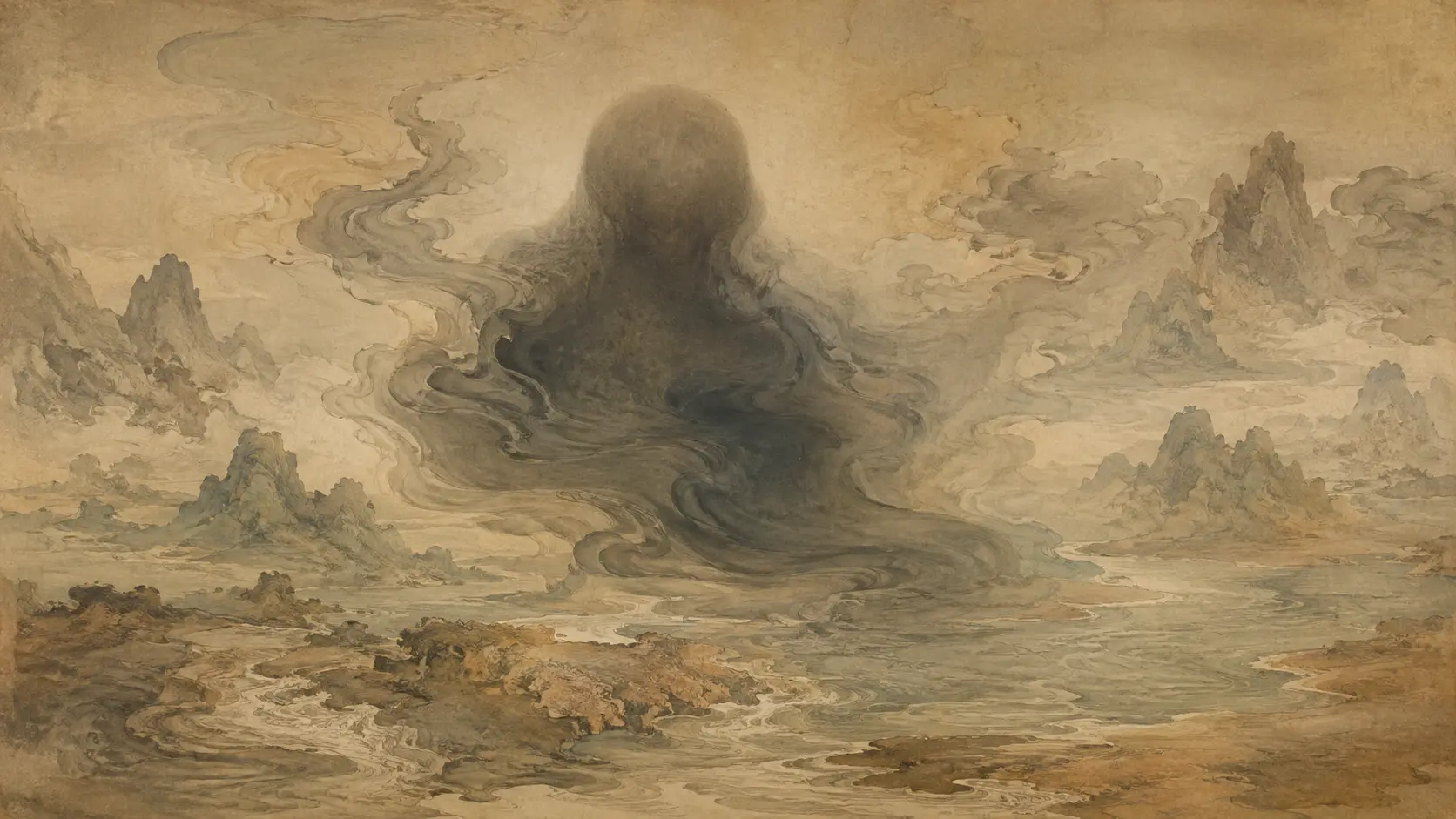
This was Hundun — the primordial chaos that existed before creation.
While many creation myths begin with a creator bringing order to nothingness, Chinese mythology often begins with something much more mysterious: a universe that already exists, but has not yet found its shape.
What Is Hundun in Chinese Mythology?
Hundun (混沌) is one of the oldest concepts connected with Chinese ideas of creation.
The word itself can be translated as chaos, confusion, or a state where things are not yet separated.
However, the ancient meaning is deeper than simple disorder.
Modern understanding often associates chaos with destruction, but in early Chinese philosophy, Hundun represented a primordial condition before distinction existed.
There was no clear separation between:
- Heaven and Earth;
- yin and yang;
- light and darkness;
- beginning and ending.
Everything existed together in an unfinished state.
Hundun was not evil.
It was the possibility from which order could emerge.
Hundun Before the Creation of Heaven and Earth
In Chinese creation traditions, the universe did not always begin with a finished world.
Instead, ancient thinkers imagined an original state where reality was still forming.
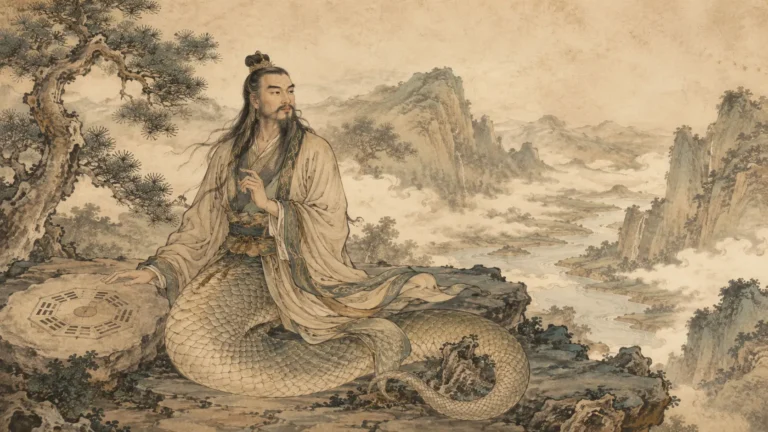
This idea connects naturally with the later story of Pangu, the legendary creator who separated Heaven and Earth from the original cosmic state.
However, Hundun and Pangu represent different parts of the creation story.
Hundun represents:
The world before separation.
Pangu represents:
The force that creates separation and structure.
The two ideas work together.
Without the original chaos, there would be nothing to transform into an ordered universe.
Hundun and the Philosophy of Ancient China
The idea of Hundun appears not only in mythology but also in ancient Chinese philosophy.
One of the most famous references comes from the Zhuangzi (庄子), a foundational Daoist text.
In this story, Hundun appears as a symbolic figure representing a natural state without artificial divisions.
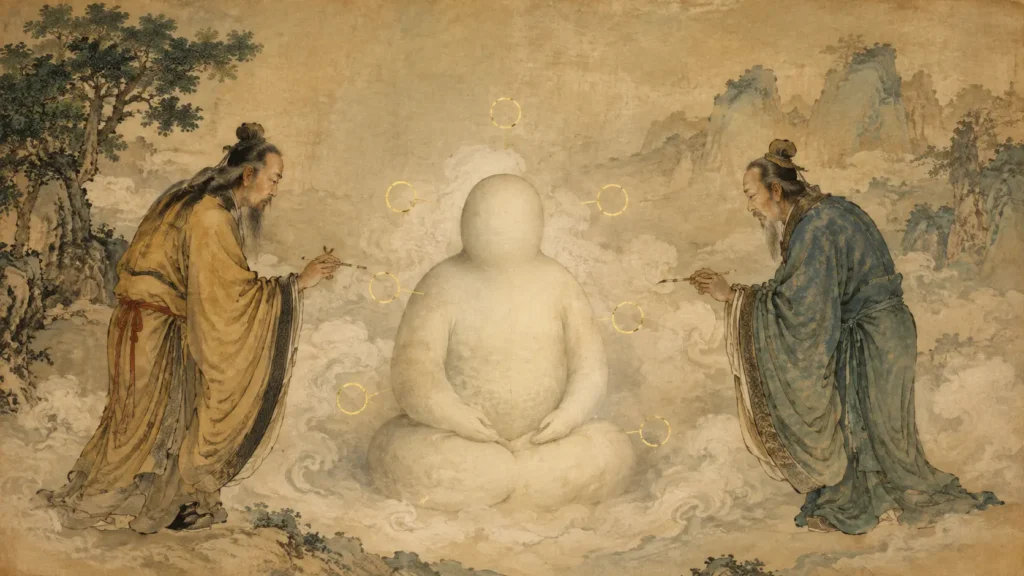
The story tells of Hundun, the ruler of the central region, who welcomes two other rulers. Wanting to repay his kindness, they decide to give him the features humans possess — openings such as eyes, ears, and a mouth.
They create these features one by one.
On the seventh day, Hundun dies.
The story is not simply about a creature dying.
It expresses a deeper Daoist idea:
Sometimes trying to force natural simplicity into an artificial structure destroys what made it complete.
Is Hundun a Creature or a Concept?
This is one of the most fascinating parts of Hundun.
Unlike creatures such as Bai Ze or Haozhi, Hundun does not have one fixed appearance across all traditions.
Sometimes it appears as:
- a symbolic representation of primordial chaos;
- a mythical being;
- a shapeless cosmic force.
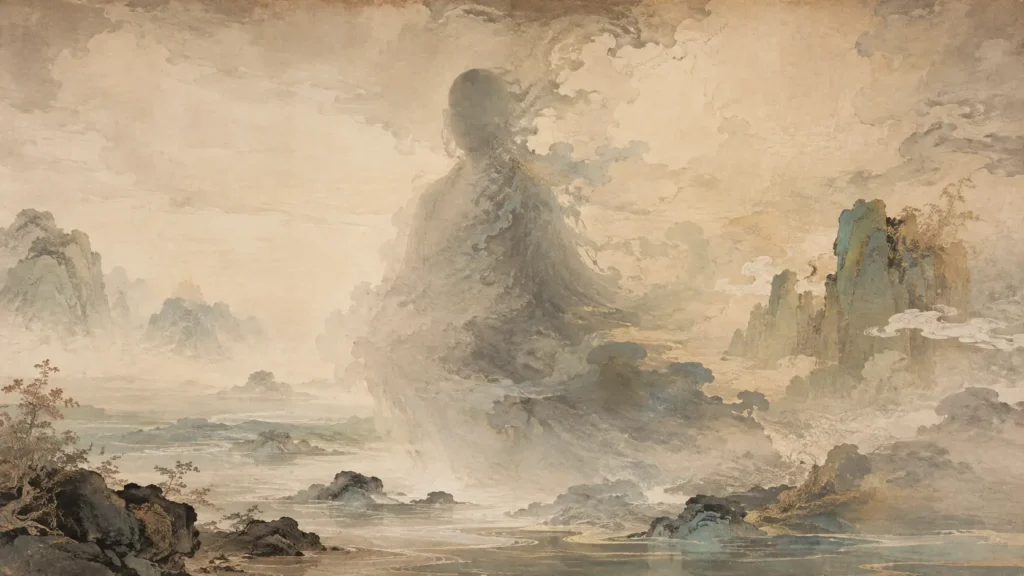
Later artistic interpretations often depict Hundun as a strange creature without normal features, reflecting the idea that it exists before the categories humans use to understand the world.
This uncertainty is part of its power.
Hundun is not frightening because it is a monster.
It is fascinating because it exists outside normal understanding.
The Connection Between Hundun and Creation Myths
Many cultures imagine creation as a movement from chaos into order.
Chinese mythology follows a similar pattern, but with a unique perspective.
The original chaos is not something that must simply be destroyed.
It is the foundation from which everything develops.
The transition looks like this:
Hundun → separation → Heaven and Earth → humanity → civilization
This makes Hundun one of the most important ideas for understanding Chinese mythology.
It represents the moment before the universe became recognizable.
Why Hundun Still Matters Today
Hundun remains fascinating because it asks one of humanity’s oldest questions:
What existed before the world became the world?
Unlike stories focused only on powerful gods or heroic battles, Hundun explores something much larger.
It represents uncertainty, possibility, and the mysterious beginning of existence itself.
In a world where humans constantly try to categorize everything, Hundun reminds us that there may have always been something before those categories existed.
Before there was order, there was possibility.
Before there was a world, there was Hundun.
Hundun in Modern Culture: Morris From Shang-Chi
Hundun found a massive new audience in 2021 through a faceless, six-legged creature named Morris in Shang-Chi and the Legend of the Ten Rings.
This is movie lore, not mythology — worth keeping the two separate. Morris is a companion to the con-man Trevor Slattery, discovered locked away in a dungeon and later revealed to be a native of Ta Lo, the film’s hidden mystical village. The creature is genuinely faceless on screen — no eyes, no mouth — because the filmmakers deliberately kept it that way. Visual effects supervisor Christopher Townsend said directly that the design is “based on a Hundun, which is a mythological character in Chinese folklore, sometimes considered the God of chaos,” and the production reportedly overruled studio pressure to give the creature eyes, choosing instead to stay faithful to the featureless figure described in the Shan Hai Jing.
Ta Lo in the film is populated with several other creatures pulled from Chinese mythology — nine-tailed foxes based on Huli Jing, horse-like beings based on the Qilin — placing Hundun in genuinely good company rather than as a one-off reference.
The film doesn’t reinterpret the myth so much as borrow its strangest detail — a being with no face at all — and build a character around staying true to that, instead of softening it.
Reference:
Chinese Text Project — Zhuangzi: The Normal Course for Rulers and Kings — original classical passage about Hundun, the rulers Shu and Hu, the seven openings, and Hundun’s death on the seventh day. Stanford Encyclopedia of Philosophy — Religious Daoism — academic discussion of Hundun as the ruler of the Center and as a representation of an undifferentiated state in Daoist thought.