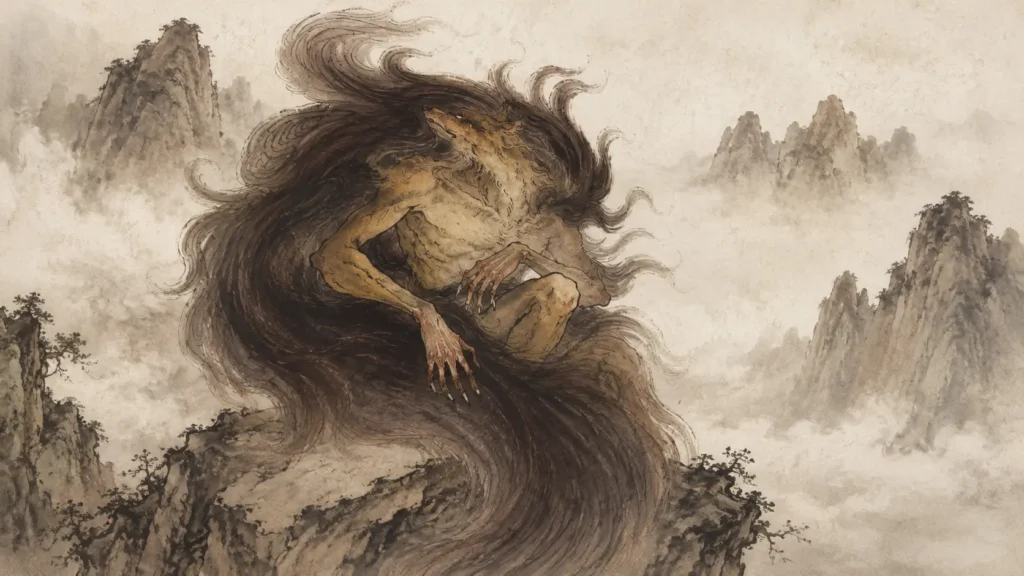
At first, the body looks human.
Then you reach the head.
Something is wrong.
The face belongs to a beast.
And in another ancient version of the same strange entry, the being becomes even harder to understand: yellow in color, dog-like, yet somehow compared with a hedgehog.
The Shan Hai Jing offers no explanation.
It simply records the impossible figure and moves on.
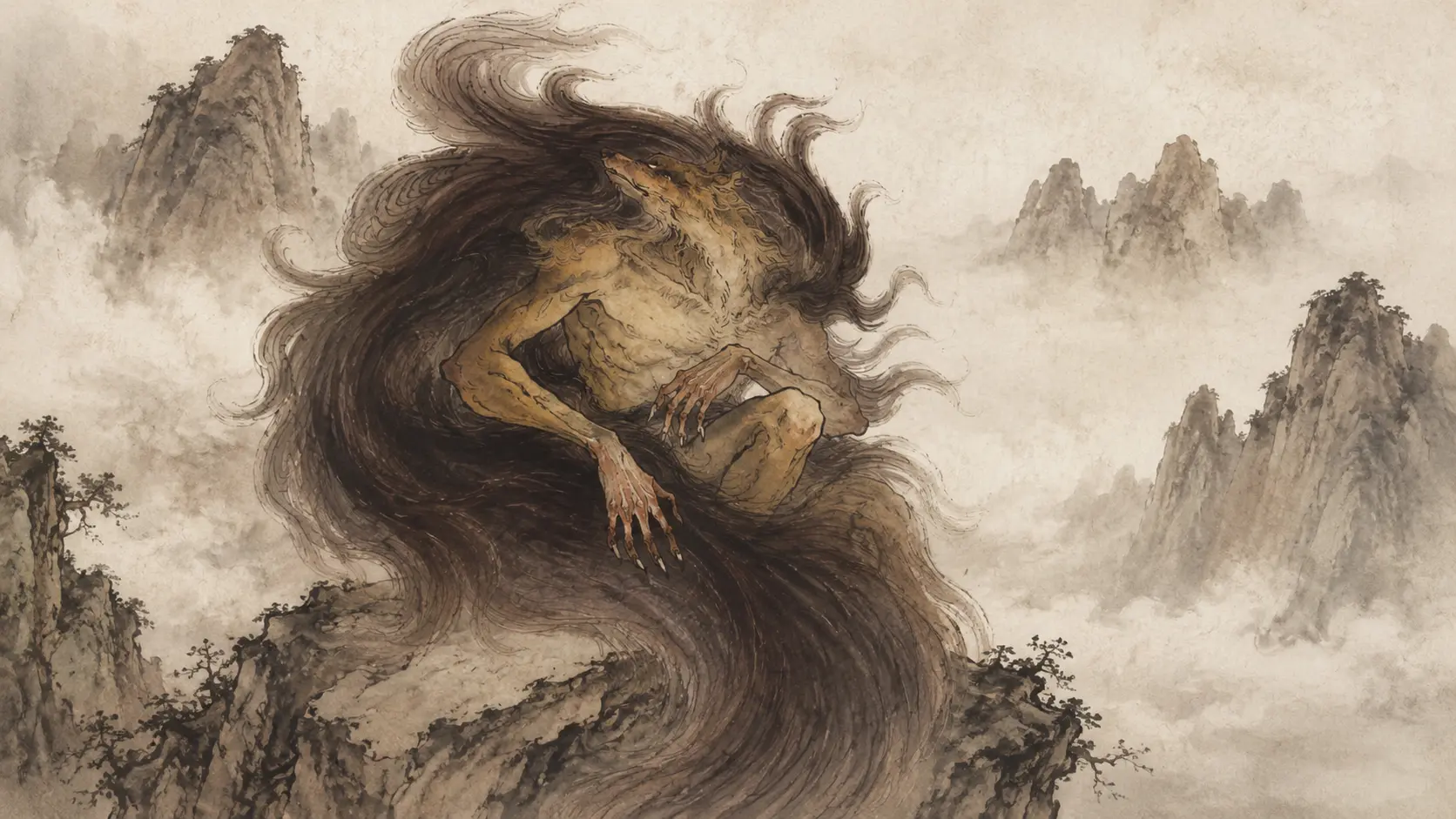
Huan Gou (环狗 / 環狗, Huán Gǒu), also transmitted in some editions as Huanju (環拘), is a mysterious people or being recorded in the Classic of the Northern Regions Within the Seas. The ancient text describes Huan Gou as having a beast’s head and a human body. An alternate account describes a yellow, dog-like, hedgehog-like form.
What Is Huan Gou?
Huan Gou appears in the Hainei Beijing (海内北经), usually translated as the Classic of the Northern Regions Within the Seas.
The surviving passage is extremely short:
環狗,其為人獸首人身。一曰蝟狀如狗,黃色。
In natural English:
Huan Gou: its people have beast heads and human bodies. Another account describes a hedgehog-like being shaped like a dog and yellow in color.
Some transmitted versions write the first name as 環拘, which Chinese Text Project romanizes as Huanju. Other historical editions preserve 環狗, matching the form used in the book shown here.
That textual variation is worth preserving rather than pretending there is only one spelling.
Beast Head, Human Body
The clearest description is:
獸首人身 — “beast head, human body.”
The text does not specify exactly which animal the head resembles in this first description.
It does not explicitly say wolf.
It does not say fox.
And despite the name containing 狗 — dog in some editions, the first description simply calls it a beast head.
That means modern illustrations showing a very specific canine face are interpretations.
The safest reconstruction is a predominantly human body beneath an unmistakably non-human animal head.
This is also one reason Huan Gou is more interesting than a normal hybrid monster.
The wording 其為人 can be read in context as describing the people associated with Huan Gou, not necessarily one unique individual creature. Chinese Text Project likewise translates Huanju collectively rather than as the personal name of a single monster.
A Yellow Dog-Like Creature?
Then the passage gives a second version.
一曰蝟狀如狗,黃色
The wording is difficult enough that translations vary slightly, but the safest reading preserves three details:
hedgehog-like, dog-shaped, yellow.
This does not fit neatly with the first image of a beast-headed human.
And that may be exactly the point.
The Shan Hai Jing frequently preserves alternate reports without attempting to reconcile them into one perfectly consistent creature.
Perhaps different traditions described Huan Gou differently.
Perhaps the underlying text changed during transmission.
We simply do not know.
What we should not do is combine every detail into a completely invented yellow human with a dog head, giant hedgehog spines, claws and magical powers.
The source never gives us that creature.
Is Huan Gou a Monster or a People?
This is one of the most important questions for understanding the entry.
Modern mythology sites often present Huan Gou as a single monster.
But the surrounding Hainei Beijing is full of unusual countries, peoples, corpses, divine figures and animals rather than a simple monster catalogue.
The grammar of the passage also makes a collective interpretation possible.
For that reason, “beast-headed people” is arguably more precise than simply calling Huan Gou a monster.
An academic discussion of the Shan Hai Jing has similarly rendered Huan-kou as beings with animal heads and human bodies, placing them among the strange peoples represented in the work’s distant geography.
So the safest description for our article is:
Huan Gou is a mysterious beast-headed people or humanoid being of the Shan Hai Jing.
That preserves the ambiguity of the ancient source.
Is Huan Gou the Same as Panhu?
The commentary in the modern book you photographed introduces the famous story of Panhu (槃瓠 / 盘瓠).
The visual connection is obvious.
Panhu is a dog associated with a story that eventually produces a dog-headed human figure.
But these traditions should not be merged automatically.
The Book of the Later Han (Hou Hanshu) records Panhu as a remarkable five-colored dog belonging to the ruler Gaoxin. When the ruler promised a reward to whoever defeated an enemy general, Panhu returned carrying the enemy’s head. The emperor eventually honored his promise by giving his daughter to Panhu, after which the pair departed into the southern mountains.
An annotation preserved with the account cites the Wei Lüe and gives another version of Panhu’s origin: something was removed from an old woman’s diseased ear, placed inside a vessel, and later transformed into a dog.
That explains why modern books may discuss Panhu beside a dog-headed figure.
But there is an important rule for our article:
The Shan Hai Jing does not say that Huan Gou is Panhu.
They are separate textual traditions unless a later source explicitly connects them.
So Panhu is useful as a comparison—not as Huan Gou’s secret identity.
What Powers Did Huan Gou Have?
None are recorded.
The ancient passage does not say Huan Gou:
- eats humans;
- predicts war;
- causes disease;
- transforms into humans;
- controls spirits;
- grants immortality;
- possesses magical weapons.
The text gives us appearance, and little else.
That separates Huan Gou from nearby creatures such as Qiongqi, which the same chapter explicitly describes as a winged, tiger-like man-eater.
If a modern source gives Huan Gou elaborate powers, those abilities should therefore be treated as later invention unless another ancient text can be produced.
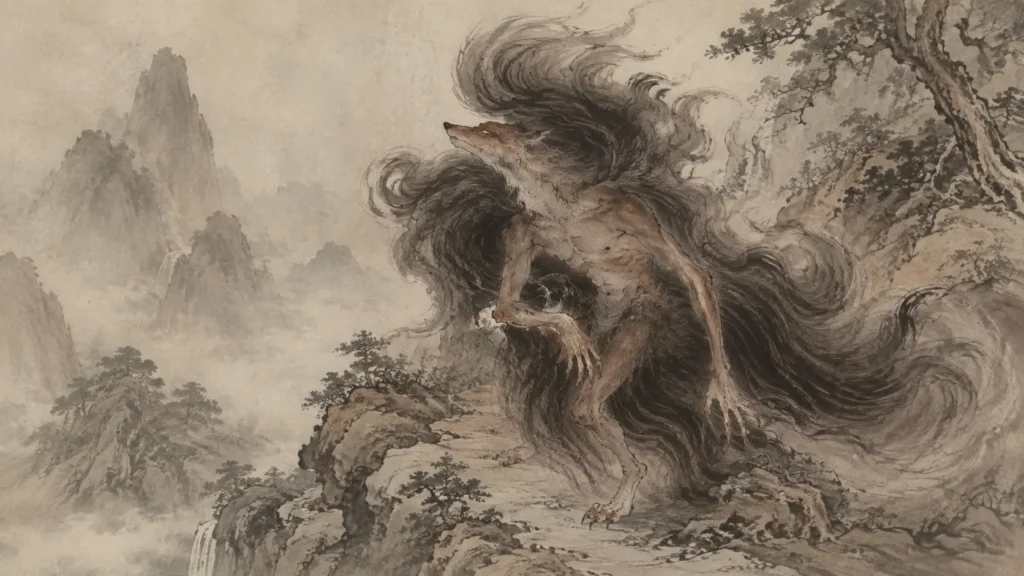
Huan Gou and the Strange Peoples of the Northern Regions
Huan Gou becomes more interesting when read in context.
The same chapter contains the Dog-Rong country, strange one-eyed beings, human-animal hybrids, Qiongqi, unusual corpses and other impossible inhabitants of the lands associated with the northern reaches of the ancient mythical world.
The Shan Hai Jing does not always distinguish between:
geography, ethnography, religion and mythology.
A distant nation can sound like a monster.
A mountain can have a god.
A strange body can describe an entire people.
Huan Gou belongs perfectly to that uncertain border.
It may be less useful to ask:
“What monster is this?”
than:
“What kind of world did the ancient authors imagine existed beyond familiar lands?”
Why Huan Gou Is Worth Remembering
The original entry is only a few words long.
Yet two images survive inside it.
In one:
a human figure stands with the head of an unknown beast.
In another:
something yellow and dog-like appears, carrying the strange comparison to a hedgehog.
No explanation connects them.
No adventure begins.
No hero arrives.
The Shan Hai Jing simply places Huan Gou among the impossible inhabitants of its vast ancient geography.
And perhaps that uncertainty is precisely why the figure survives.
Thousands of years later, we still cannot say exactly what Huan Gou was supposed to be.
We only know that somewhere within the strange northern world of the Shan Hai Jing, human and beast were not always separate things.
Reference: