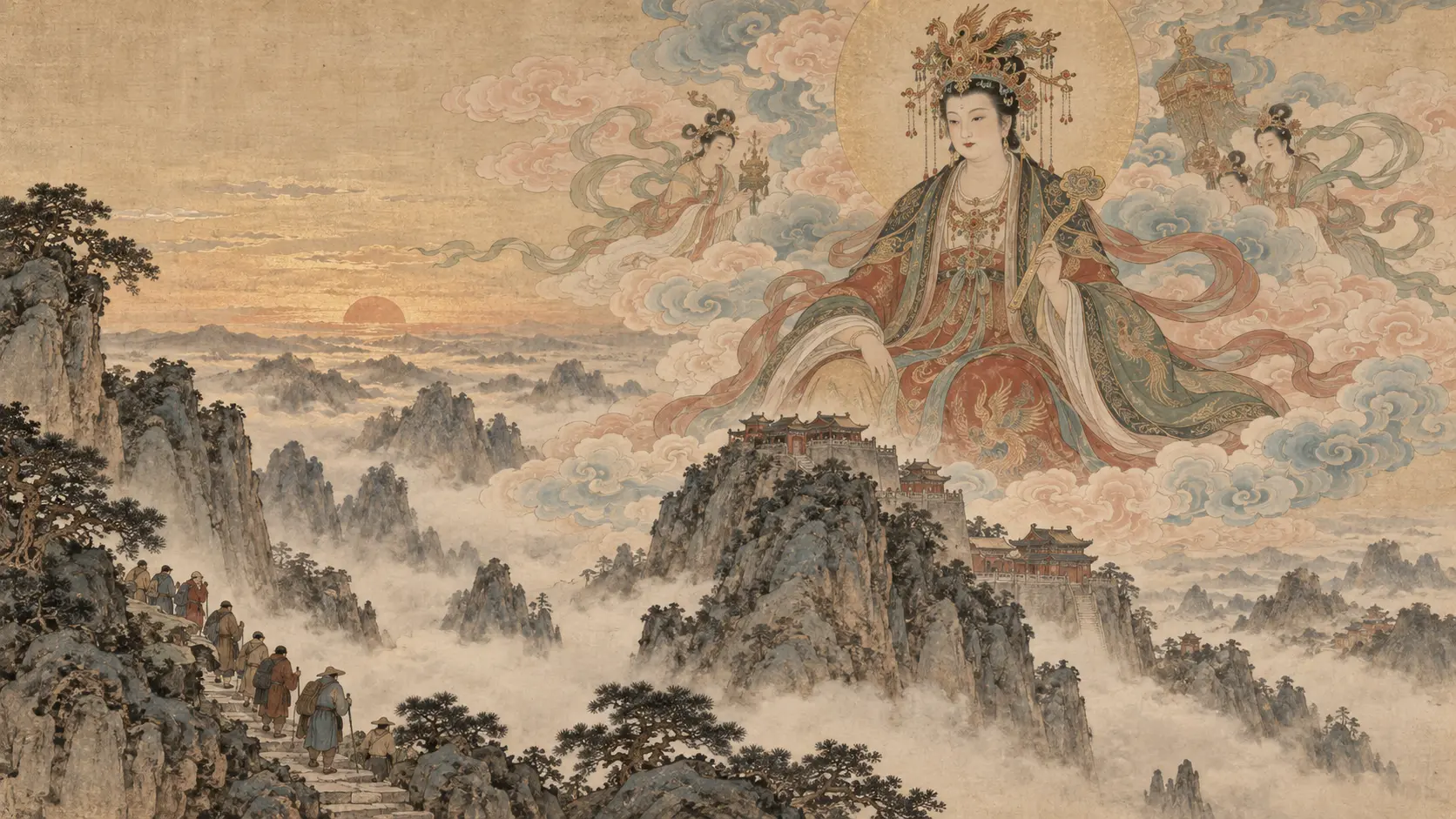
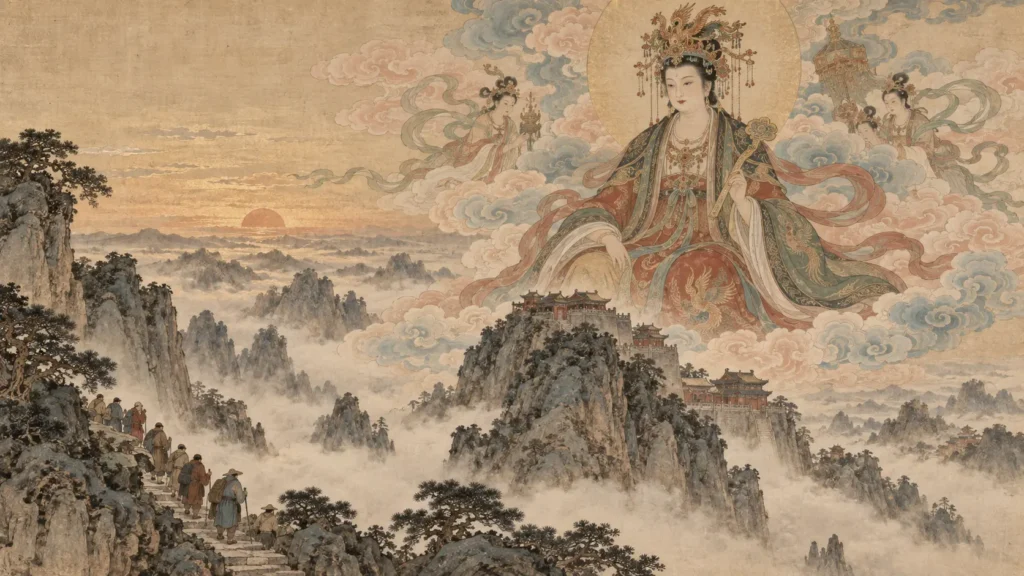
Before sunrise, pilgrims climbed.
Stone steps vanished into mist above them. Incense smoke drifted between mountain gates. Families had travelled for days — sometimes much longer — for one reason.
At the summit of Mount Tai, one of China’s most sacred mountains, waited a goddess people believed could hear requests that touched the most fragile parts of human life.
Children.
Health.
Protection.
Family.
Her name was Bixia Yuanjun (碧霞元君, Bìxiá Yuánjūn) — the Lady of Mount Tai.
And by the late imperial period, her worship had become so powerful that she rivalled the ancient male deity who had ruled the mountain for centuries.
Bixia Yuanjun at a Glance
| Chinese name | 碧霞元君 |
| Pinyin | Bìxiá Yuánjūn |
| Common names | Taishan Niangniang 泰山娘娘 · Taishan Nainai 泰山奶奶 |
| Main sacred place | Mount Tai 泰山 · Shandong |
| Tradition | Daoism and Chinese popular religion |
| Known for | Childbirth · descendants · protection · health · blessings |
| Major cult period | Ming and Qing dynasties |
| Main temple | Bixia Temple near the summit of Mount Tai |
| Origin | Multiple competing traditions rather than one fixed biography |
Who Is Bixia Yuanjun?
Bixia Yuanjun is the Daoist and popular-religious goddess most closely associated with Mount Tai in Shandong. She became especially famous as a protector of childbirth, descendants and family welfare, while Daoist scripture gives her a much wider role protecting people, extending life, removing calamity and judging moral conduct.
She is affectionately known as Taishan Niangniang, “Lady of Mount Tai,” and Taishan Nainai, “Grandmother of Mount Tai.”
Calling her simply a “fertility goddess” therefore misses much of the picture.
People sought children from her.
But they also sought protection from disease, disaster and misfortune.
Her authority reached far beyond the birthing room.
What Does the Name Bixia Yuanjun Mean?
Bixia (碧霞) evokes colored, azure or rosy clouds.
Yuanjun (元君) is a high Daoist title often translated as “Primordial Sovereign” or “Primordial Lady.”
That produces English renderings such as Primordial Sovereign of the Azure Clouds, Lady of the Azure Clouds, or Princess of the Colored Clouds.
There is no single English translation that perfectly captures the Chinese title.
But the imagery fits her sacred landscape.
At Mount Tai, dawn rises through clouds surrounding one of China’s most revered peaks.
Bixia Yuanjun became inseparable from that mountain.
How Old Is Bixia Yuanjun?
This question is more complicated than many mythology websites suggest.
Older stories connect female divine figures with Mount Tai, and traditions surrounding a Taishan Yunu (泰山玉女) — a “Jade Maiden of Mount Tai” — existed before Bixia Yuanjun became famous.
But a detailed study of the historical evidence found no surviving written record using the name Bixia Yuanjun before the fifteenth century. Her recognizably later cult expanded rapidly during the Ming period.
That distinction is important.
It means we should not take every later legend about her ancient origins and automatically treat it as ancient history.
The mountain’s female sacred traditions may be older.
The fully developed Bixia Yuanjun cult appears later.
By the mid-to-late sixteenth century, however, her rise was extraordinary. Scholarship on northern Chinese religion describes a major shift in Mount Tai worship toward Bixia Yuanjun, and by the Qing dynasty hundreds of shrines in Shandong alone were associated with her.
Was Bixia Yuanjun the Daughter of the God of Mount Tai?
According to one famous tradition, yes.
Popular accounts describe Bixia Yuanjun as the daughter of Dongyue Dadi (東嶽大帝), the Great Emperor of the Eastern Peak and ancient divine ruler associated with Mount Tai.
But that is one origin story, not a universally fixed biography.
Other traditions describe her as a heavenly Jade Maiden.
Another later account tells of a mortal girl who cultivated the Dao on Mount Tai and attained immortality.
Daoist reference traditions preserve several competing explanations rather than one single origin.
Late-imperial scholars themselves argued about the problem.
Some criticized the idea that she was literally the daughter of the Mount Tai god and tried to connect her instead with older Jade Maiden traditions.
So the safest answer is:
Bixia Yuanjun has multiple origin traditions, and none should be presented as the one historical biography of the goddess.
Why Did People Pray to Bixia Yuanjun for Children?
This became one of the most important parts of her worship.
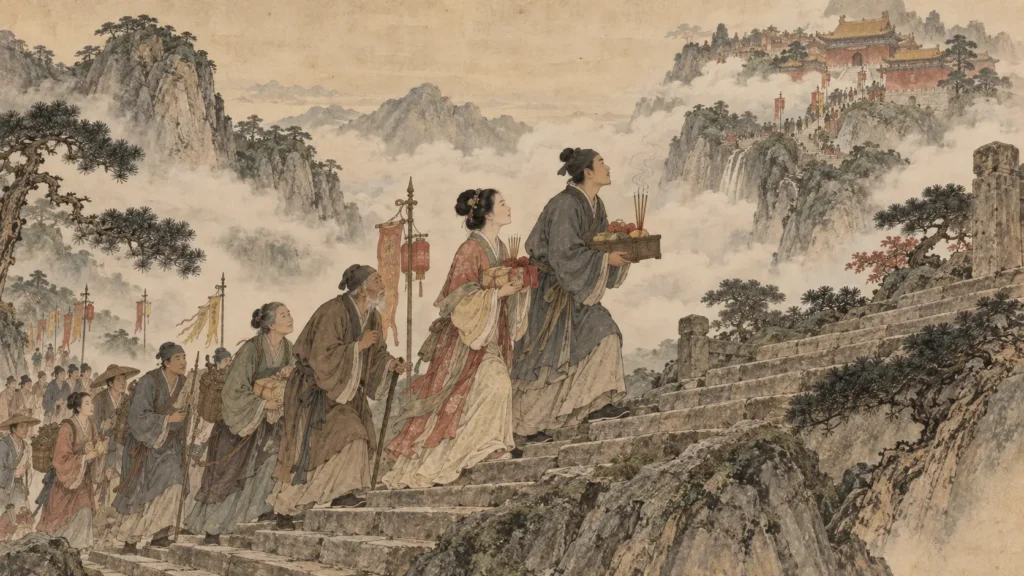
Historical research into late-imperial pilgrimages to Mount Tai shows that ordinary families travelled in large numbers to her summit sanctuary. One major motive was the hope of receiving a child — especially an heir.
Women were central to the cult, but these journeys were not exclusively female.
Men and women travelled together in families and pilgrimage associations.
For people facing infertility, illness or uncertainty about their family’s future, reaching the goddess at the summit could become the final act of a long religious journey.
That relationship between mountain and birth may seem strange at first.
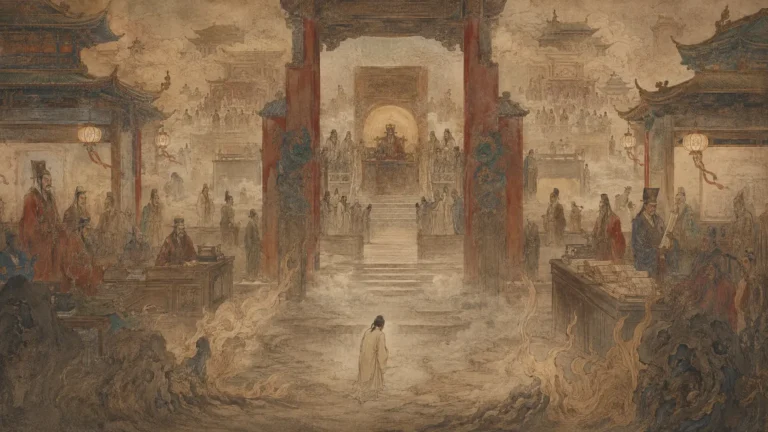
But Mount Tai had long been associated with the boundaries of human existence — life, death, fate and the supernatural administration of souls.
Bixia Yuanjun gradually became the compassionate female face of that sacred landscape.
Bixia Yuanjun Was More Than a Childbirth Goddess
A Daoist scripture dedicated to her, the Bixia Yuanjun Huguo Bimin Puji Baosheng Miaojing, gives her an enormous range of responsibilities.
She protects the country and its people.
She supports loyalty and filial conduct.
She is invoked to protect life, extend descendants, remove disasters, overcome danger and drive away disease and harmful forces.
The same text also portrays her as commanding supernatural forces connected with Mount Tai and observing human good and evil.
This explains why reducing Bixia Yuanjun to “the goddess who gives babies” is misleading.
Childbirth became one of her most famous functions.
Her theological authority was much broader.
Why Is Mount Tai So Important to Bixia Yuanjun?
Mount Tai is not merely where one of her temples happens to stand.
It is the center of her identity.
For centuries, Mount Tai was one of the most politically and religiously important mountains in China. Emperors performed major state rituals there, while popular religion connected the mountain with supernatural power over human life and death.
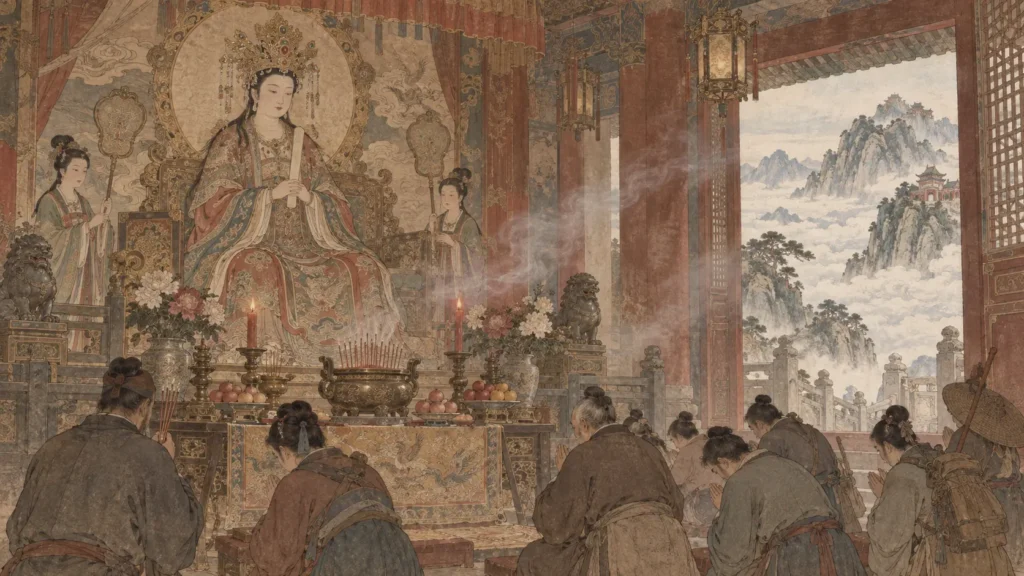
Near its summit stands Bixia Temple, today one of the mountain’s most important Daoist sacred sites.
The Mount Tai administration dates the temple complex’s foundation to 1008 during the Song dynasty, although the cult and identity attached to Bixia Yuanjun developed considerably in later centuries. The present complex became a major pilgrimage destination dedicated to her.
That nuance matters.
The sacred site has an older institutional history than the securely documented name “Bixia Yuanjun.”
Those are not contradictions.
Religious places and the gods worshipped within them can evolve together.
How Powerful Did Her Cult Become?
Very powerful.
By the late Ming and Qing periods, Bixia Yuanjun was no longer merely a local mountain goddess.
Her cult spread throughout northern China.
Pilgrimage societies organized journeys to her sanctuaries. Temples and subsidiary shrines appeared far beyond Mount Tai. Worship connected with her even became an important part of the religious landscape around Beijing.
Her popularity eventually became so great that the focus of popular Mount Tai devotion shifted significantly away from the older male mountain deity toward Bixia Yuanjun herself.
That transformation is perhaps the most remarkable part of her story.
She was not simply inserted into an existing pantheon.
She changed its center of gravity.
Why Bixia Yuanjun Still Matters
Bixia Yuanjun’s mythology is quieter than the stories of dragons, demons and celestial wars.
There is no single battle that defines her.
No monster she must defeat.
Her power comes from something more human.
People climbed a mountain because there were things in life they could not control.
Whether a child would be born.
Whether someone would recover.
Whether a family would survive misfortune.
Whether prayers spoken far below Heaven could be heard at all.
At the summit of Mount Tai, Bixia Yuanjun became the figure people trusted with those questions.
And perhaps that explains why her worship became so powerful.
Not every god needs to conquer an enemy.
Some become unforgettable because people believed they were listening.
References
For the history of the cult, one of the strongest sources is the Kyoto University study showing the distinction between earlier Taishan Yunu traditions and the later emergence of Bixia Yuanjun as a clearly documented deity in the fifteenth century.
Brian Dott’s academic study of late-imperial Mount Tai pilgrimage is especially useful for understanding ordinary pilgrims and the importance of seeking children and heirs.