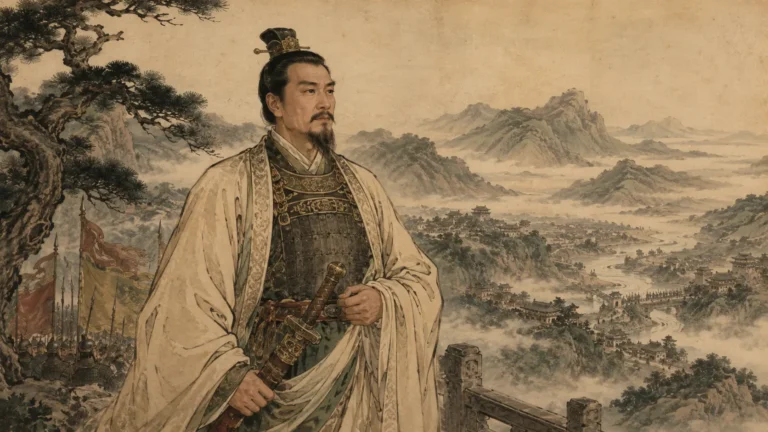
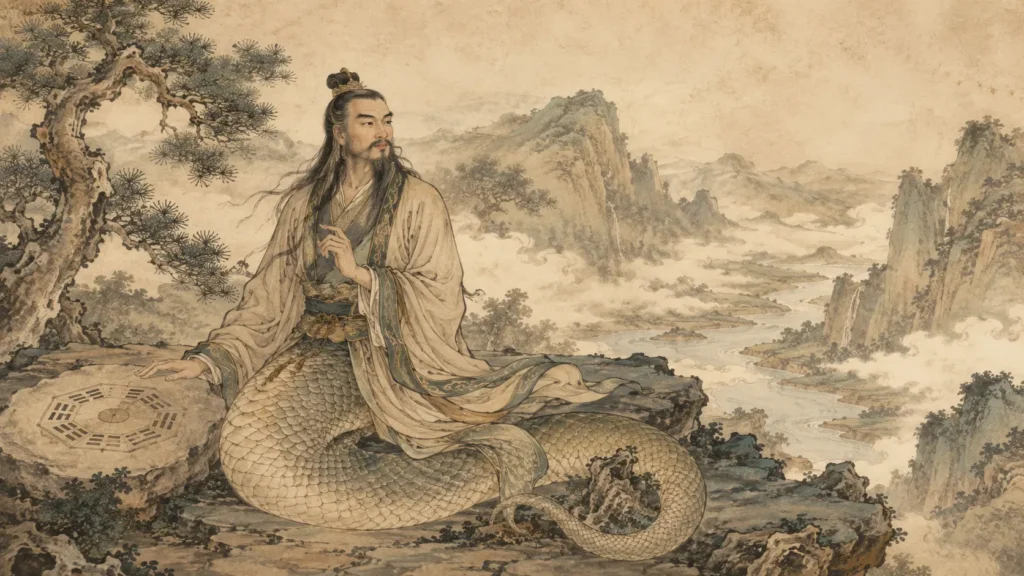
Before there were emperors in palaces, armies beneath banners, or scholars writing commentaries about Heaven and Earth, Chinese tradition imagined a ruler standing beneath the open sky.
He looked upward.
He studied the stars.
He looked down at the land beneath his feet.
He watched birds and animals.
Then he searched for patterns connecting them all.
His name was Fuxi.
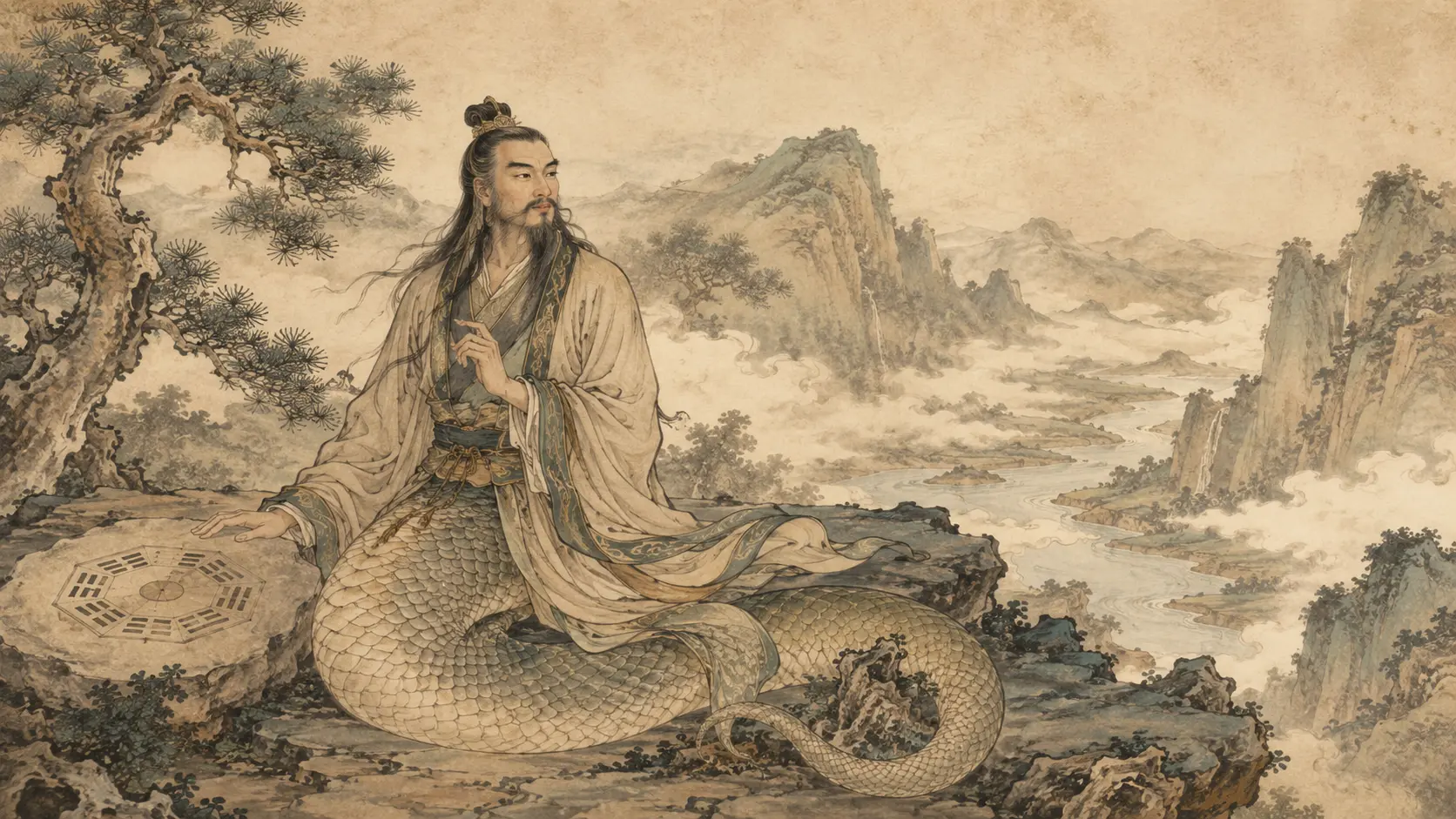
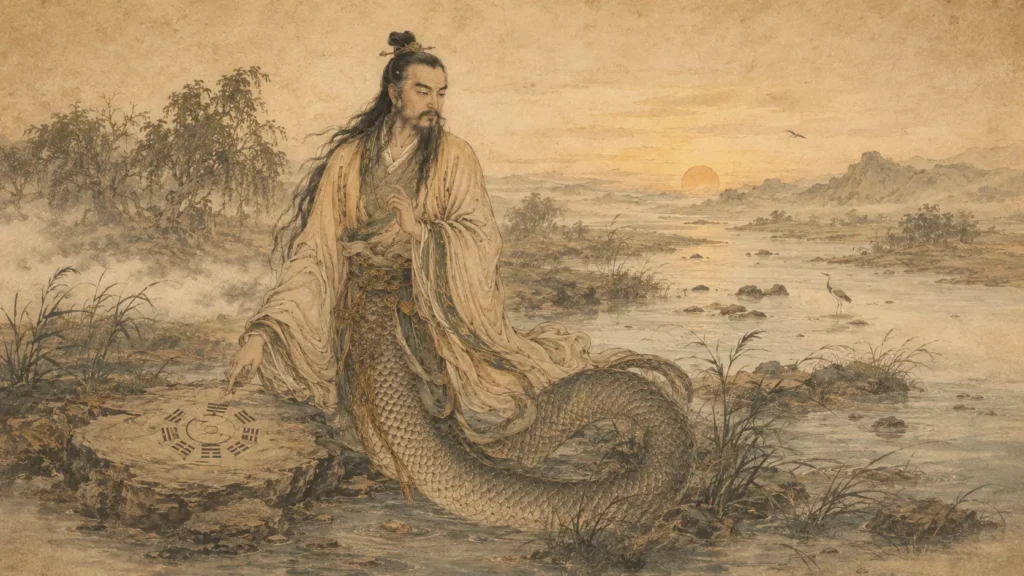
And according to one of China’s most important classical traditions, those observations led him to create the Eight Trigrams — Bagua.
But Fuxi was remembered for more than divination.
He became an ancestral ruler, a culture hero, the legendary inventor of hunting and fishing nets, a member of the Three Sovereigns, and the figure most often paired with the creator goddess Nüwa.
Fuxi (伏羲, Fúxī), also written Fu Xi and known in older texts as Bao Xi or Paoxi, is a primordial culture hero and legendary ruler in Chinese mythology. The Book of Changes tradition credits him with creating the Eight Trigrams, or Bagua, after observing patterns in Heaven, Earth, animals, and the natural world. It also attributes to him the invention of knotted nets for hunting and fishing. Later traditions closely pair Fuxi with Nüwa, and historical art often depicts both with human upper bodies and intertwined serpent-like tails.
Who Is Fuxi in Chinese Mythology?
Fuxi belongs to the imagined beginning of civilization.
He is not a historical emperor whose reign can be reconstructed from contemporary records. Rather, he is a legendary ancestral sovereign and culture hero through whom later Chinese tradition explained the origins of knowledge, social order, and important technologies.
Different texts even write his name differently.
The Yijing tradition calls him Bao Xi (包犧), while later sources commonly use Fuxi (伏羲). Other names and identifications accumulated around him over time.
This layered identity is important.
There is no single ancient “Fuxi biography.”
Instead, different generations remembered him as:
a ruler,
an ancestor,
a sacred figure,
and most importantly, a man who turned observation of nature into human knowledge.
Fuxi and the Eight Trigrams — Bagua
Fuxi’s strongest classical association comes from the Xici commentary attached to the Book of Changes.
The text describes the ancient ruler Bao Xi observing the world:
仰則觀象於天,俯則觀法於地……於是始作八卦
He looked upward at the patterns of Heaven and downward at the patterns of Earth, observed animals and the conditions of the land, considered what was near in the human body and what was distant in the surrounding world—and then began to create the Eight Trigrams.
Those Eight Trigrams are known as:
八卦 — Bāguà
Each trigram is formed from three lines arranged as combinations of broken and unbroken forms.
Together, they became part of the symbolic foundation of the Yijing, or Book of Changes, representing recurring patterns through which change in the world could be understood.
And that makes the Fuxi story surprisingly powerful.
He does not receive the Bagua by simply declaring them.
He begins by observing.
Sky.
Earth.
Animals.
The human body.
The world close at hand.
The world far away.
Fuxi’s great mythological act is therefore the transformation of pattern into knowledge.
Did Fuxi Write the I Ching?
Not exactly.
This is an important distinction because many modern summaries say simply:
“Fuxi invented the I Ching.”
That compresses a much longer textual history into one sentence.
The classical tradition specifically credits Fuxi with beginning the Eight Trigrams. The Yijing itself developed through multiple historical layers and should not simply be treated as a book personally written by Fuxi.
So the more accurate answer is:
Fuxi is traditionally regarded as the originator of the Bagua, the Eight Trigrams that became fundamental to the later Book of Changes tradition.
That is both stronger and more precise.
The Dragon-Horse and the River Diagram
One of the most beautiful later Fuxi legends adds a supernatural visitor.
A strange dragon-horse — lóngmǎ (龍馬) emerges from the Yellow River carrying a mysterious pattern.
Fuxi studies the markings.
From them, he understands the structure that becomes the Eight Trigrams.
The pattern becomes known as the Hetu (河圖), or River Diagram.
A version preserved in the Shui Jing Zhu says that in the time of Fuxi, he received the Dragon-Horse Diagram from the Yellow River and that it was connected with the Eight Trigrams.
But we should separate this from the earlier Xici account.
The Xici emphasizes Fuxi observing Heaven, Earth, animals, himself, and the world around him.
The dragon-horse story belongs to a later layer of the tradition.
Both became part of Fuxi mythology.
They just did not originate as one single account.
Fuxi Taught Humanity to Fish and Hunt
The same Yijing passage that credits Fuxi with the Bagua immediately gives him another invention.
It says he:
作結繩而為罔罟
made nets by knotting cords, which were then used for hunting and fishing.
This detail changes how we should understand Fuxi.
He is not merely a mystical philosopher staring at symbols.
His knowledge has practical consequences.
The Bagua helps humans understand patterns.
The net helps them survive.
Later tradition would attribute many more civilizing inventions to Fuxi, but those claims come from different texts and periods and should not all be treated as though they appear in the same ancient source.
The early Yijing tradition gives us something cleaner:
Fuxi observes nature and turns what he learns into tools.
Fuxi and Nüwa
No discussion of Fuxi is complete without Nüwa (女媧).
Today the two are among the most recognizable paired figures in early Chinese mythology.
But their relationship is complicated.
Different traditions describe them as primordial ancestors, siblings, spouses, or closely connected sacred rulers. Later textual traditions even preserve the idea that Huaxu gave birth to Fuxi and Nüwa as brother and sister, while other traditions make the pair husband and wife.
Historical art makes their connection unmistakable.
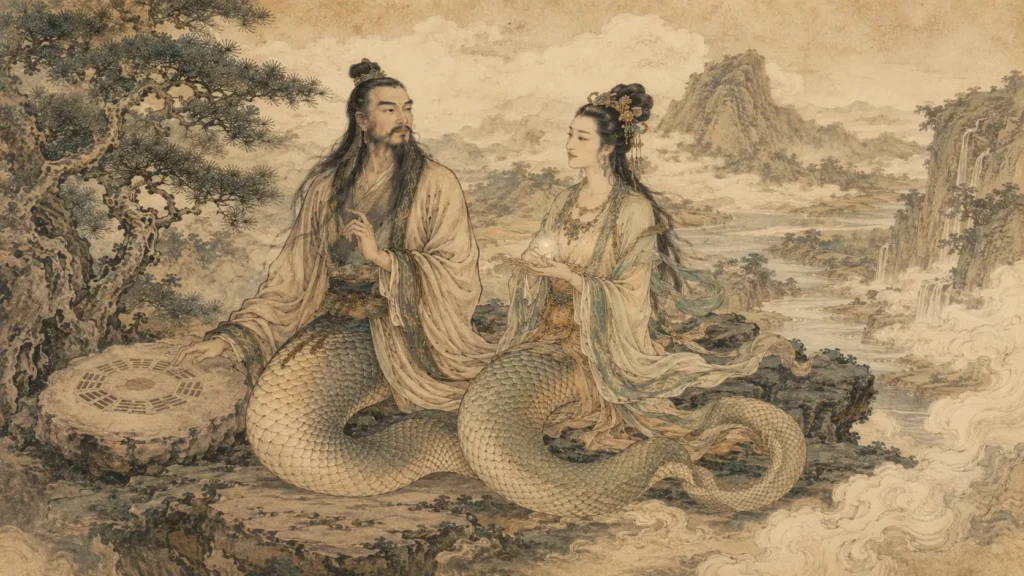
A surviving funerary banner in the British Museum depicts Fuxi and Nüwa with intertwined serpentine bodies, while the National Museum of Korea preserves another painting in which both have human upper bodies and serpent-like lower bodies.
The latter also shows them holding instruments traditionally interpreted as a compass and bent square, placed within a cosmic field containing the Sun, Moon, and stars.
Visually, the message is extraordinary:
two primordial beings,
human above,
serpentine below,
surrounded by the structure of the cosmos.
For Nüwa’s own creation myths, read Nüwa: The Chinese Creator Goddess.
Did Fuxi and Nüwa Create Humanity Together?
This is another place where modern retellings often become too neat.
Nüwa’s independent tradition of creating human beings should not automatically be rewritten as a single Fuxi-and-Nüwa creation story.
Their mythologies developed through different textual layers.
Later traditions strongly pair them as primordial ancestors and sometimes as the couple through whom humanity continues, but that does not mean every ancient account of Nüwa creating humans originally included Fuxi beside her.
This distinction actually makes the pair more interesting.
Nüwa becomes associated especially with creating and protecting human life.
Fuxi becomes associated especially with knowledge, patterns, tools, and civilization.
They overlap.
But they are not duplicates.
Why Is Fuxi Shown With a Snake Body?
Many historical representations show Fuxi with a human upper body and serpent-like lower body, often intertwined with Nüwa’s tail.
The iconography is not a modern fantasy invention.
Examples survive in funerary art from early medieval China, including works from the Astana cemetery tradition.
However, we should be careful when explaining what that body “means.”
Modern interpretations sometimes claim that the serpent automatically symbolizes fertility, yin-yang balance, dragons, immortality, or cosmic energy.
Some of those interpretations may be interesting.
But there is no need to pretend the serpent body had one universally explained meaning in every period.
What the surviving art proves is simpler:
the hybrid human-serpent image became one of the most important visual identities of Fuxi and Nüwa.
That alone is remarkable.
Was Fuxi One of the Three Sovereigns?
Yes—in many traditions. But the list of the Three Sovereigns was not fixed.
Chinese sources preserve several different groupings.
One Han tradition gives:
Fuxi, Nüwa, and Shennong.
Other lists replace Nüwa with Suiren, Huangdi, Zhurong, or Gonggong. Fuxi appears repeatedly across these competing systems and eventually became one of the most established primordial sovereigns of traditional Chinese legendary history.
So saying:
“Fuxi was one of the Three Sovereigns”
is correct as a broad traditional description.
Saying:
“There was only one canonical list of the Three Sovereigns”
would not be.
Was Fuxi a God, Emperor, or Culture Hero?
All three labels can appear, depending on the tradition.
Calling him a culture hero is especially useful because so many stories about Fuxi explain how human beings acquired knowledge.
Calling him a legendary sovereign reflects the traditional historical framework that placed primordial rulers before later emperors.
And religious traditions could honor him as a sacred ancestral figure.
What we should avoid is presenting Fuxi as though historians possess evidence for an actual emperor who personally ruled China on an exact date thousands of years BCE.
Fuxi belongs to mythic antiquity, not documented political history.
Fuxi, Nüwa, and the Beginning of Civilization
There is a beautiful contrast between Fuxi and Nüwa when their stories are placed beside one another.
Nüwa looks at an empty world and gives humanity life.
Fuxi looks at a confusing world and searches for patterns inside it.
One myth asks:
Where did people come from?
The other asks:
How did people learn to understand the world around them?
That is why the connection between these two figures deserves more than a random internal link.
Together, they form one of the strongest foundational clusters in Chinese mythology.
Nüwa → humanity and restoration
Fuxi → knowledge and civilization
And above both stands the larger question of how ancient Chinese tradition imagined the transition from a primordial world into an ordered human one.
Why Fuxi Still Matters
Fuxi does not need to defeat a demon to be powerful.
His greatest weapon is observation.
He looks into the sky.
Then at the earth.
Then at animals.
Then at himself.
And slowly, the chaos of the world begins to form a pattern.
Lines become trigrams.
Cord becomes a net.
Observation becomes survival.
Nature becomes knowledge.
Perhaps that is why Fuxi survived for thousands of years.
He represents an idea more important than any single invention:
civilization begins when human beings stop merely living inside the world—and begin trying to understand it.
Reference:
Chinese Text Project — Book of Changes, Xi Ci II
The most important classical source used here for Fuxi/Bao Xi observing Heaven and Earth, creating the Eight Trigrams, and making nets for hunting and fishing.
Chinese Text Project — Shui Jing Zhu, Yellow River
Preserves the later Dragon-Horse / River Diagram tradition connecting Fuxi with the Hetu and Bagua.
Chinese Text Project — Fengsu Tongyi, Three Sovereigns
Preserves one ancient list naming Fuxi, Nüwa, and Shennong as the Three Sovereigns.