The world was alive, but it was empty.
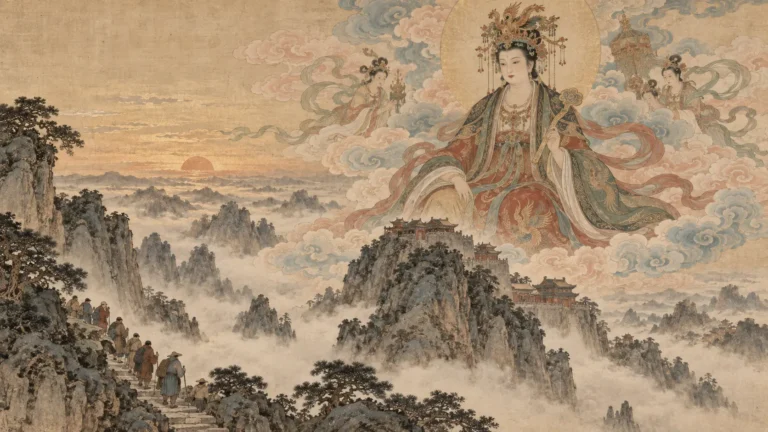
Mountains rose above the clouds. Rivers crossed the land. Birds filled the skies, and wild animals moved through the forests.
Yet there were no human voices.
According to Chinese mythology, Nüwa looked upon this silent world and decided to create a new kind of life. She gathered yellow clay from the earth, shaped it with her hands, and gave birth to humanity.
But Nüwa was more than a creator.
She became the mother of human beings, a guardian of marriage, and the goddess who would later return when the heavens themselves began to collapse.
Who Is Nüwa?
Nüwa, written 女娲 in simplified Chinese and 女媧 in traditional Chinese, is one of the oldest and most important goddesses in Chinese mythology.
She is best known as the creator of human beings.
In different traditions, Nüwa appears as a goddess, an ancient ruler, a mother of humanity, and one of the legendary figures responsible for bringing order to the early world.
Her myths developed over many centuries. Because of this, there is no single version of her complete story.
Some accounts describe Nüwa acting alone. Others place her beside Fuxi, another ancient creator figure. She may be presented as his sister, his wife, or his divine partner.
However, the central image of Nüwa remains the same.
She is the goddess who gave humanity life and refused to abandon it when the world became dangerous.
What Did Nüwa Look Like?
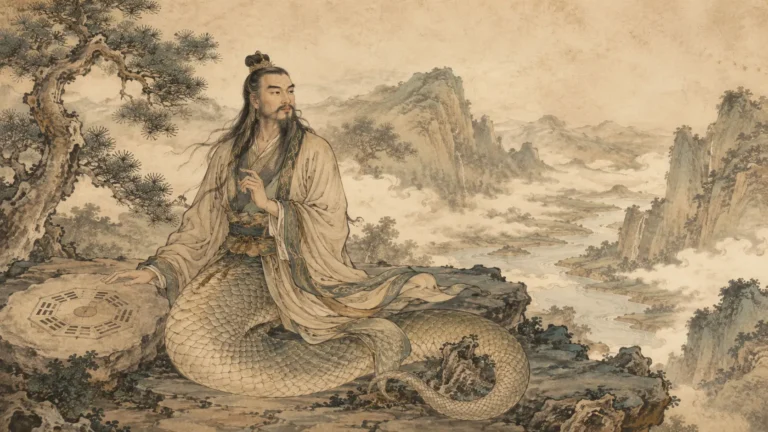
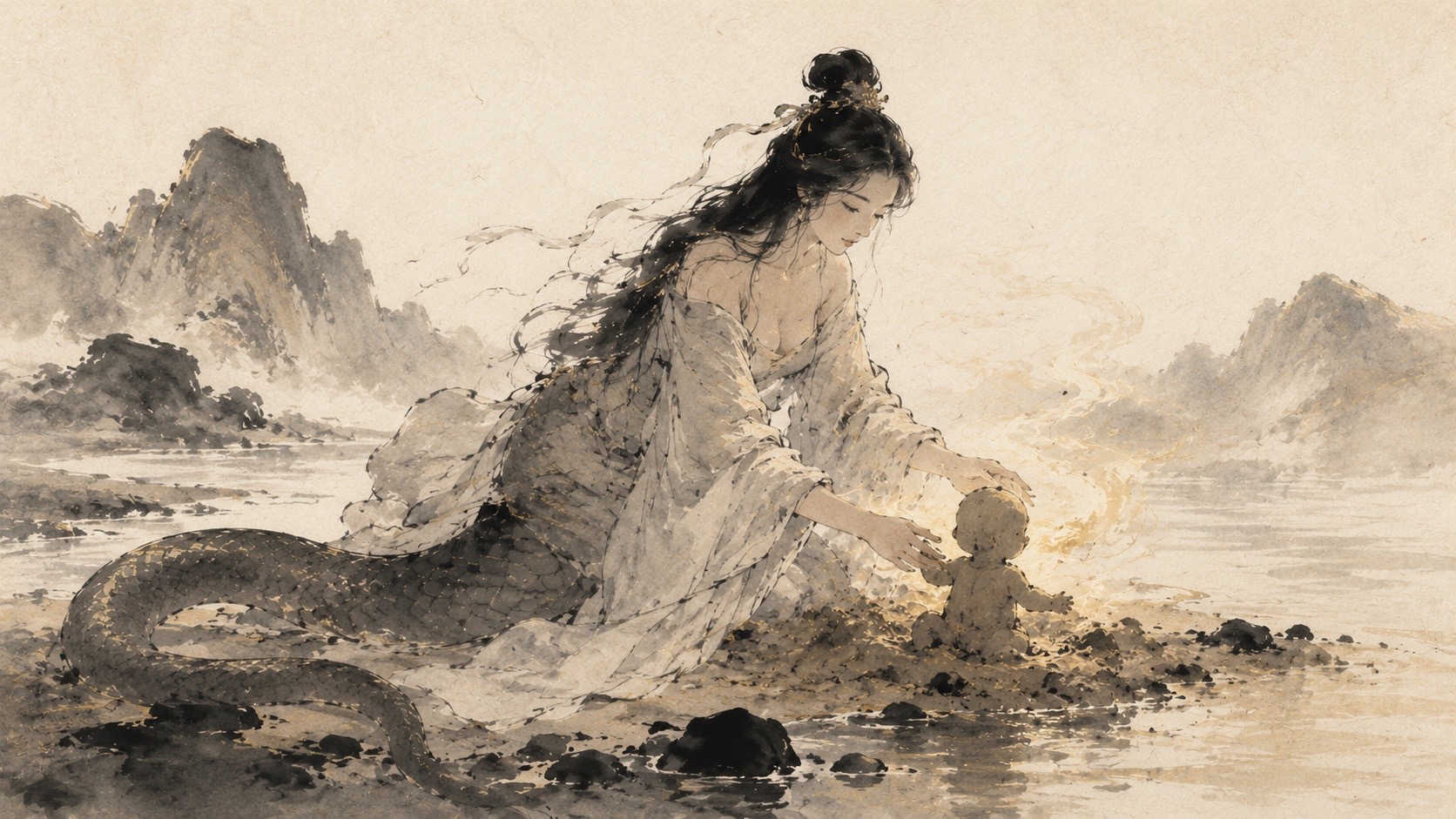
Nüwa is often shown with the upper body of a woman and the long tail of a serpent or dragon.
Her appearance may seem unusual today, but serpent-like bodies were not necessarily symbols of evil in ancient Chinese culture.
They could represent transformation, fertility, water, natural power, and a connection with the forces that existed before human civilization.
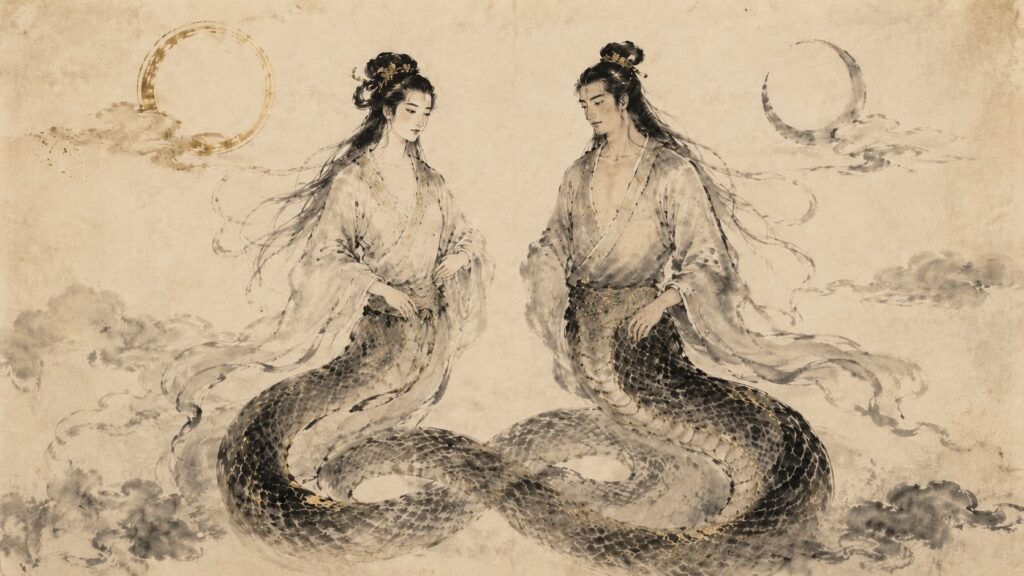
Nüwa is frequently depicted beside Fuxi. Their long tails twist together beneath their human bodies, showing that the two figures are closely connected.
In some ancient images, Nüwa holds a compass while Fuxi carries a carpenter’s square.
These tools represent the ability to shape and measure the world.
The compass creates circles, while the square creates straight lines and angles. Together, they symbolize balance, structure, and the creation of cosmic order.
Nüwa’s body therefore connects two worlds.
Her human form represents the people she created, while her serpent tail connects her with nature and the ancient powers of the earth.
How Did Nüwa Create Humanity?
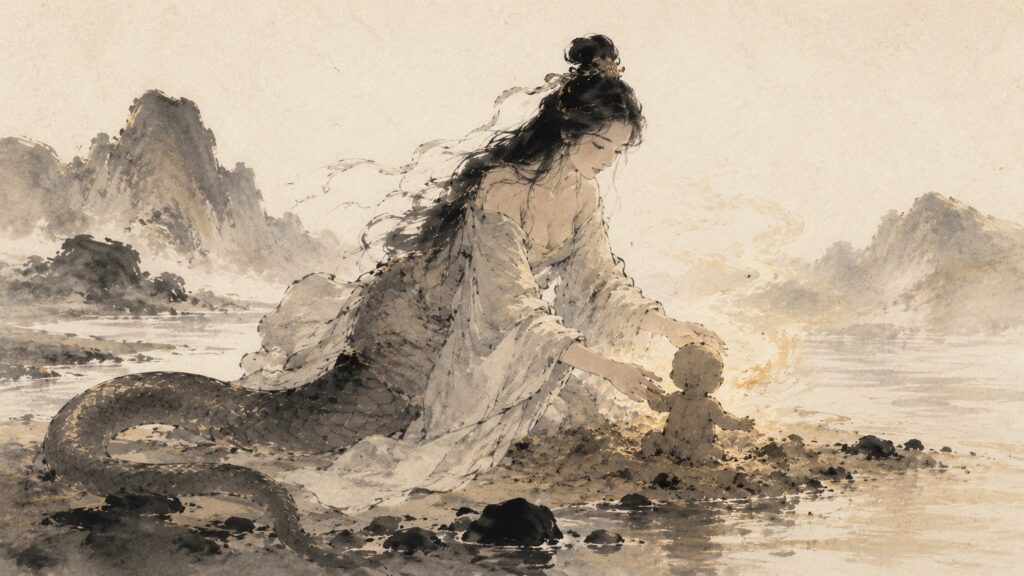
According to the most famous version of the myth, Nüwa created human beings from yellow clay.
The world around her was beautiful, but she felt lonely. Although animals lived everywhere, none of them could speak to her or understand the world in the same way she did.
One day, Nüwa stopped beside a river and looked at her reflection in the water.
She decided to create a living figure that resembled her.
Nüwa gathered wet yellow earth from the riverbank and began shaping it with her hands. She formed a small head, a body, arms, and legs.
When she placed the figure on the ground, it came to life.
The creature stood, moved, laughed, and spoke.
Nüwa was delighted.
She continued shaping more figures, and soon the silent world became filled with human voices.
Each person was made from the earth but carried a small part of the goddess who had created them.
Why Did Nüwa Use a Rope?
Creating every human being by hand required enormous time and effort.
Nüwa could shape only one person at a time, but the earth was vast. She wanted humanity to spread across the world.
She therefore found a faster method.
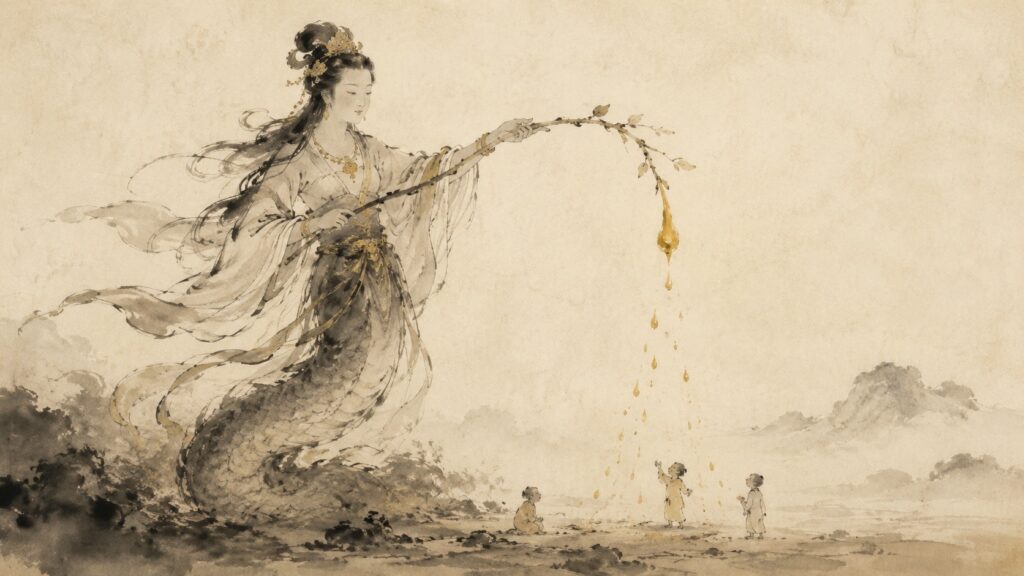
Nüwa dipped a rope, cord, or vine into wet mud. She then swung it through the air, scattering drops of clay across the ground.
Each drop transformed into another human being.
This part of the myth explains how Nüwa created humanity on such a great scale. It also introduces one of the more controversial interpretations of the story.
Some later versions claimed that the people carefully shaped by Nüwa’s hands became rich and powerful, while those formed from scattered drops became ordinary people.
This interpretation reflects the social hierarchy of later periods rather than a universal message of the myth.
At its heart, the story says something simpler.
Every human being came from the same earth.
Whether shaped carefully by hand or born from a falling drop of clay, all people received life from Nüwa.
Why Was Humanity Made from Yellow Earth?
The use of yellow clay connects human life directly with the land.
Yellow earth was familiar throughout ancient northern China, particularly in regions shaped by the Yellow River and the surrounding soil.
By creating people from clay, the myth presents humanity as part of nature rather than separate from it.
People are formed from the same material beneath their feet.
Clay also has a special quality. It begins soft and shapeless, but skilled hands can transform it into almost any form.
Nüwa does not discover humanity already completed.
She creates it carefully.
The myth therefore, presents human life as something fragile, shaped from ordinary earth but given extraordinary potential.
It also carries a warning.
What comes from the earth remains dependent upon it. Humanity cannot survive without the natural world from which it was created.
Nüwa and Fuxi
Nüwa is often connected with Fuxi, one of the legendary founders of Chinese civilization.
Fuxi is traditionally associated with knowledge, hunting, fishing, divination, social order, and the Eight Trigrams.
Nüwa is more closely connected with creation, fertility, marriage, protection, and the continuation of human life.
Together, they represent two sides of civilization.
Nüwa creates the people.
Fuxi helps teach them how to live.
In ancient artwork, the pair may appear with intertwined tails, surrounded by stars, the sun, and the moon. Their bodies create an image of union and cosmic balance.
However, their relationship changes between different traditions.
Some myths describe them as brother and sister. Others present them as husband and wife. In certain versions, they are the only two beings to survive a great disaster and become the ancestors of a new humanity.
These stories should not be forced into one perfect timeline.
Chinese mythology was never a single book with one official version. It grew through oral traditions, ancient texts, local beliefs, religious ideas, and generations of retelling.
Why Is Nüwa Connected with Marriage?
Nüwa became associated with marriage because creating the first human beings was not enough.
Humanity also needed a way to continue after the original generation disappeared.
According to later traditions, Nüwa established marriage so that men and women could form families and have children.
She therefore became connected with fertility, matchmaking, weddings, and the continuation of the human race.
Some stories place this responsibility within her relationship with Fuxi.
In one version, Nüwa and Fuxi find themselves alone after a great disaster. They wish to rebuild humanity but are uncertain whether they should marry because they are siblings.
They ask Heaven for a sign.
Different retellings describe smoke joining together, clouds surrounding them, or another supernatural event that approves their union.
The meaning of the story is not simply romantic.
Marriage is presented as a responsibility that allows human life and society to continue.
For this reason, Nüwa was remembered not only as the goddess who created humanity but also as one who protected its future.
What Does Nüwa Symbolize?
Nüwa represents creation, motherhood, fertility, balance, and responsibility.
Her myths begin with the creation of life, but they do not end there.
She gives humanity a place in the natural world. She helps establish marriage and family. When the world later falls into chaos, she returns to protect the people she created.
Nüwa therefore symbolizes more than the moment of birth.
She represents the duty that follows creation.
To create something is to become responsible for what happens to it.
Her serpent body connects humanity with nature. Her clay figures connect people with the earth. Her relationship with Fuxi represents balance and cooperation.
Most importantly, her actions show that power does not always appear through war or conquest.
Nüwa’s greatest strength is her ability to create, protect, and restore.
The Goddess Who Returned When Heaven Broke
Nüwa’s story did not end after she created humanity.
When the pillars supporting Heaven collapsed, the sky broke apart. Fires spread across the land, floodwaters rose, and wild creatures attacked the helpless.
Humanity faced destruction.
Nüwa could have watched from the heavens, but she chose to act.
She gathered five-colored stones, melted them together, and used them to repair the broken sky. She rebuilt the pillars of Heaven and restored balance between the world above and the earth below.
This later myth reveals the full meaning of her character.
Nüwa was not only the goddess who gave humanity life.
She was the goddess who returned to save it.
Read the complete story of how Nüwa mended the sky and restored Heaven.
The Mother of Humanity
Nüwa remains one of the most powerful figures in Chinese mythology because her story speaks to the relationship between humanity and the world around it.
People are created from the earth.
They survive through cooperation and family.
They remain vulnerable when nature falls out of balance.
Nüwa’s mythology reminds us that creation is not a single act that can be completed and forgotten.
Life must be protected.
What is damaged must sometimes be rebuilt.
And even when the world feels empty, broken, or silent, something new can still be shaped from the earth.