According to Chinese mythology, the world was created by Pangu, a primordial giant who emerged from a cosmic egg at the beginning of time. After separating Heaven and Earth, Pangu spent thousands of years holding them apart while the universe took shape. When he finally died, his body transformed into the natural world, becoming the mountains, rivers, wind, sun, moon, and stars. The story of Pangu is one of the oldest and most important creation myths in Chinese mythology.
Who Was Pangu?
Before there was Sun Wukong.
Before there was the Jade Emperor.
Before dragons, immortals, demons, and heavenly armies.
There was only chaos.
Chinese mythology begins with a being known as Pangu (盘古), the giant creator of the world. While many cultures tell stories of gods creating the universe through magic, the Chinese creation myth is different.
The world was not spoken into existence.
It was built through struggle.
And it came at a tremendous cost.
The Universe Was Once a Cosmic Egg
In the beginning, there was no Heaven and no Earth.
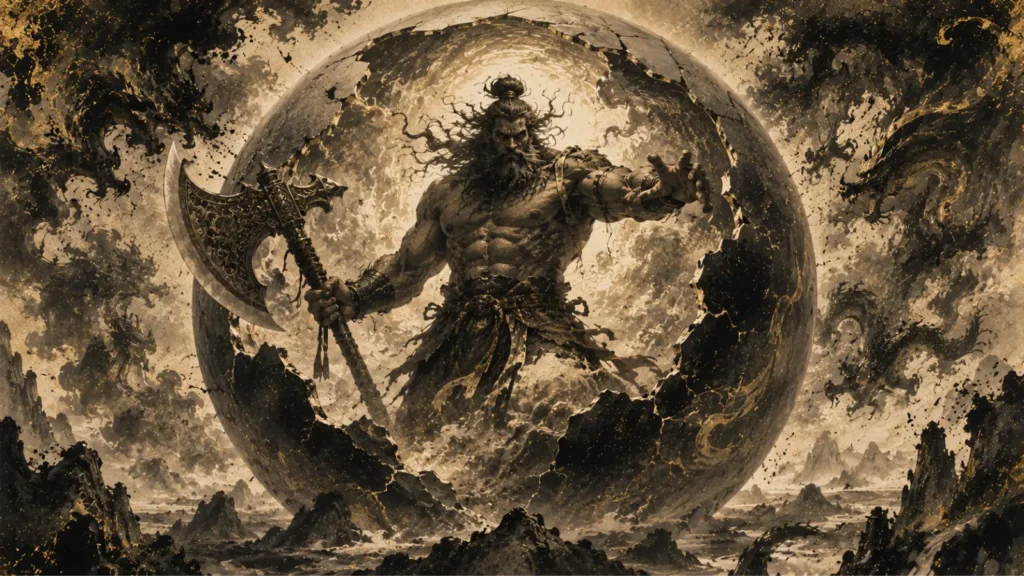
Everything existed inside a giant cosmic egg.
Within this egg, all things were mixed together:
Light and darkness.
Order and chaos.
Life and death.
Nothing had yet taken form.
For thousands of years, Pangu slept inside this endless void.
As he grew, the pressure within the egg increased.
Eventually, he awoke.
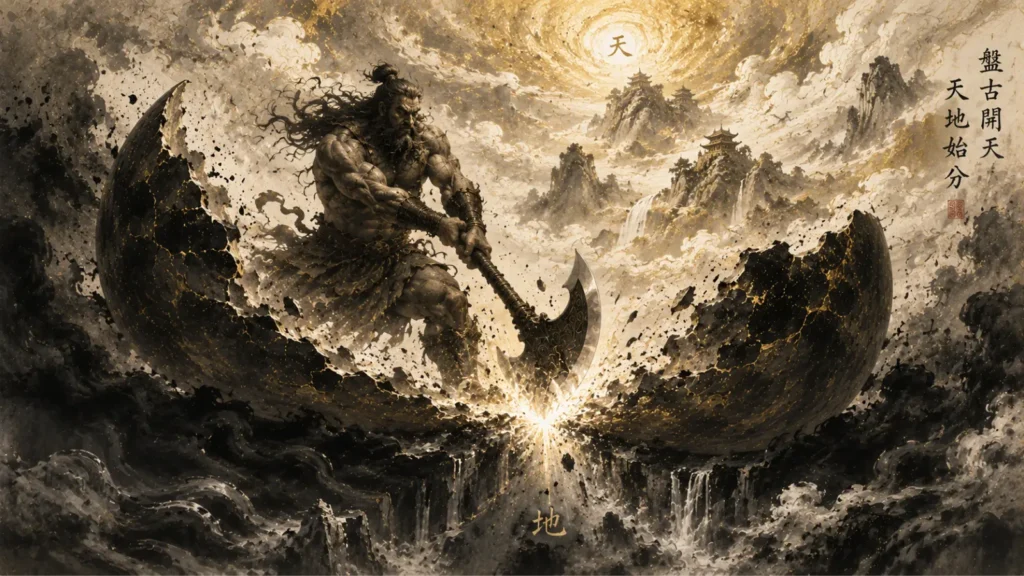
And with a mighty swing of his axe, he split the cosmic egg in two.
The lighter elements rose upward and became Heaven.
The heavier elements sank downward and became Earth.
For the first time, the universe had shape.
Pangu Holds Heaven and Earth Apart
The newly formed world was unstable.
Heaven and Earth threatened to collapse back together.
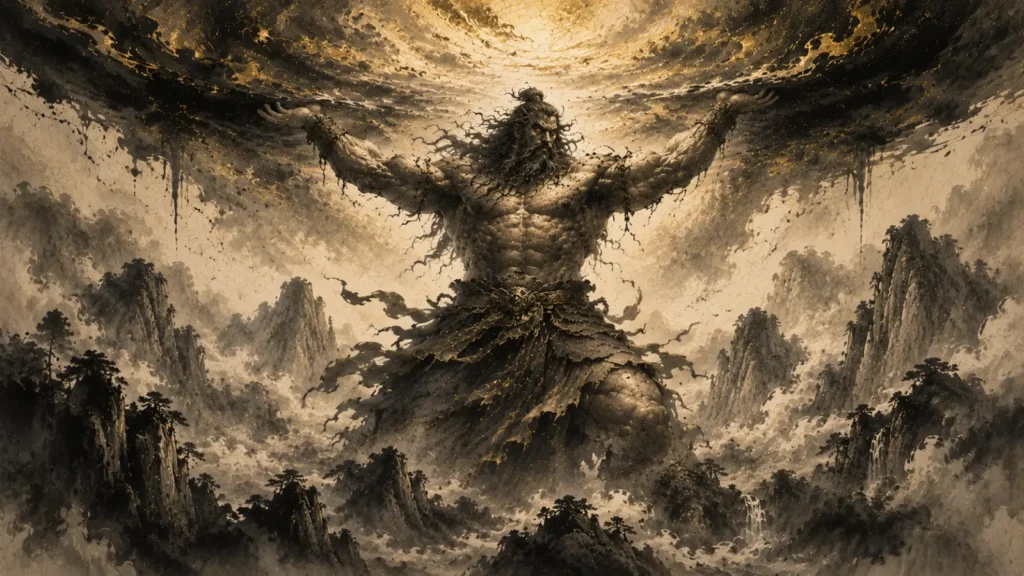
So Pangu stood between them.
Every day, Heaven rose higher.
Every day, Earth grew thicker.
And every day, Pangu grew taller.
According to the legend, this continued for 18,000 years.
Alone.
Without rest.
Without reward.
His task was simple:
Keep the world from falling back into chaos.
Many people see this as the first warrior story in Chinese mythology.
Not a story about battle.
A story about responsibility.
How Pangu Created the World
After thousands of years, Heaven and Earth became stable.
Pangu’s work was finally complete.
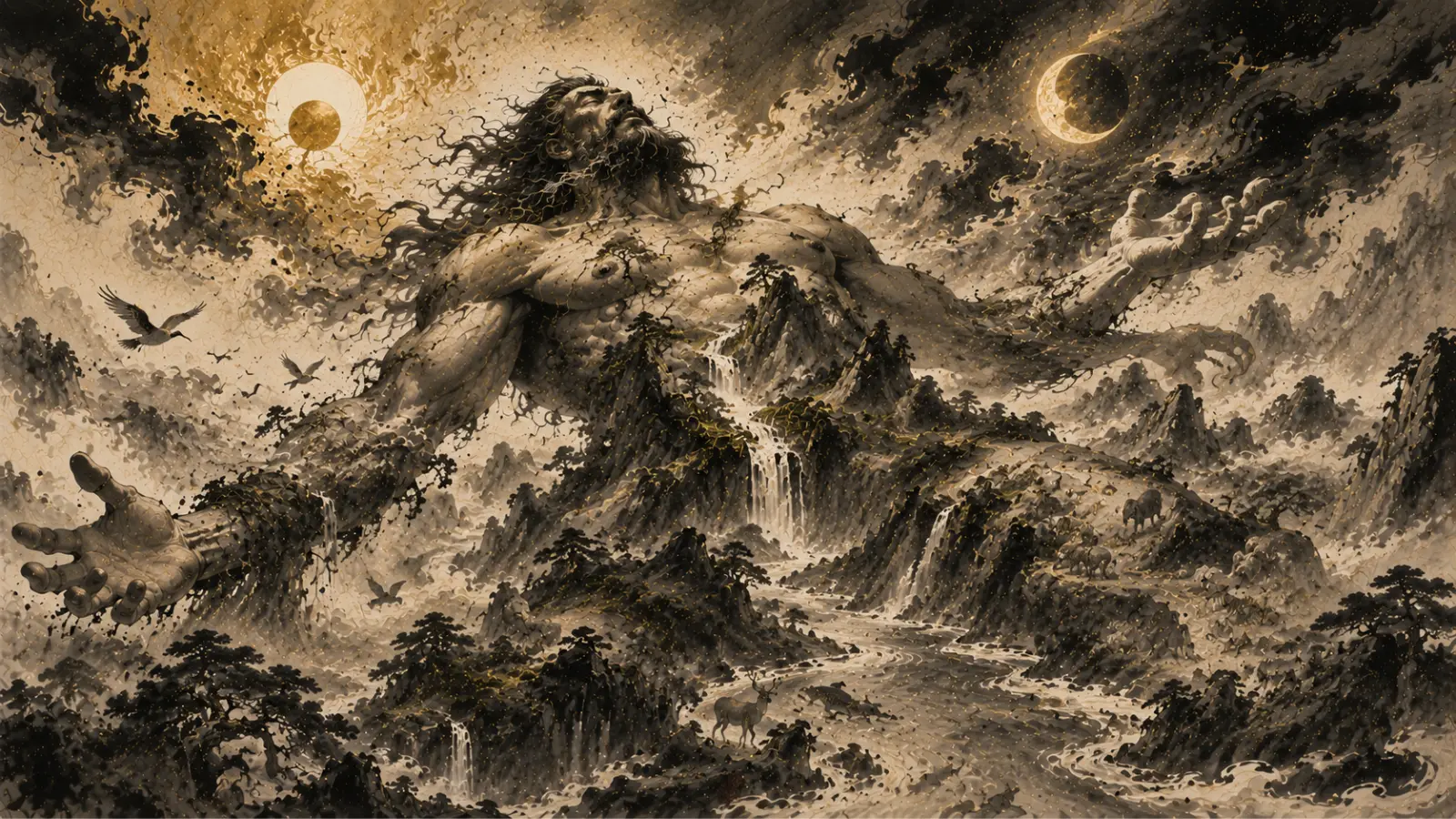
Exhausted, he died.
But his death was not the end.
It was the beginning of everything else.
According to the myth:
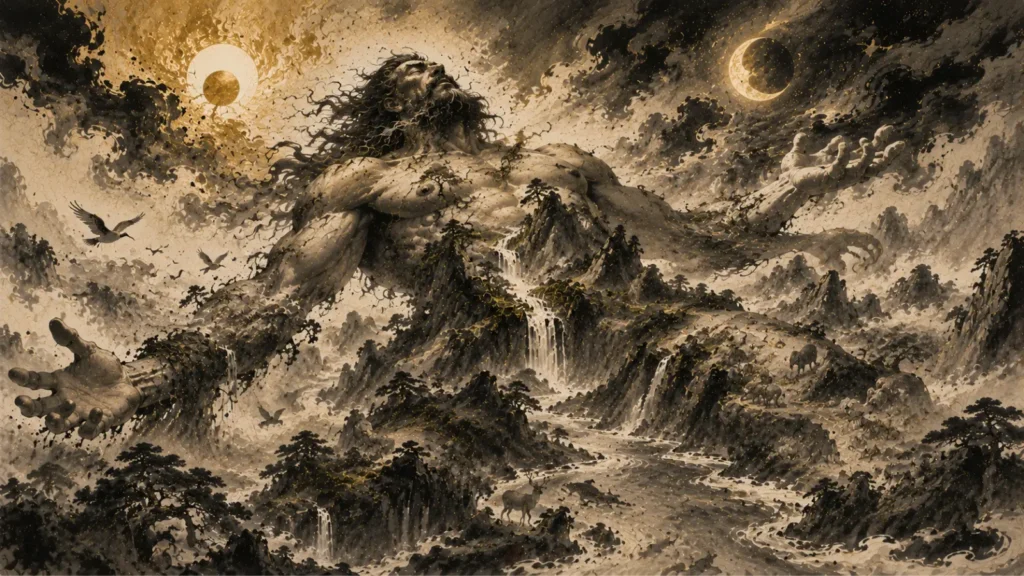
- His breath became the wind.
- His voice became thunder.
- His left eye became the sun.
- His right eye became the moon.
- His blood became rivers.
- His muscles became fertile land.
- His bones became mountains.
- His hair became forests and stars.
The world itself was formed from his body.
Every mountain, river, and valley carried a part of Pangu within it.
What Does Pangu Symbolize?
On the surface, Pangu is a giant creator god.
But beneath the story lies a deeper message.
Pangu represents the transformation of chaos into order.
He symbolizes sacrifice, discipline, endurance, and responsibility.
His story teaches that meaningful things are not created instantly.
They are built over time.
The strongest kingdoms.
The strongest bodies.
The strongest minds.
All begin in chaos.
And all require effort to create.
Why Pangu Still Matters Today
Most modern people know Sun Wukong.
Far fewer know Pangu.
Yet without Pangu, there would be no Chinese mythology.
No Heaven.
No Earth.
No immortals.
No Monkey King.
His story reminds us of a simple truth:
Before greatness comes creation.
Before victory comes work.
Before order comes chaos.
Pangu’s greatest power was not strength.
It was the willingness to carry a burden long enough for a better world to emerge.
If you want to become better and be more like Pangu, join the warrior training.
Thousands of years later, that lesson remains just as relevant.